

FAQ
FAQ—Page of common questions & answers for quick reference
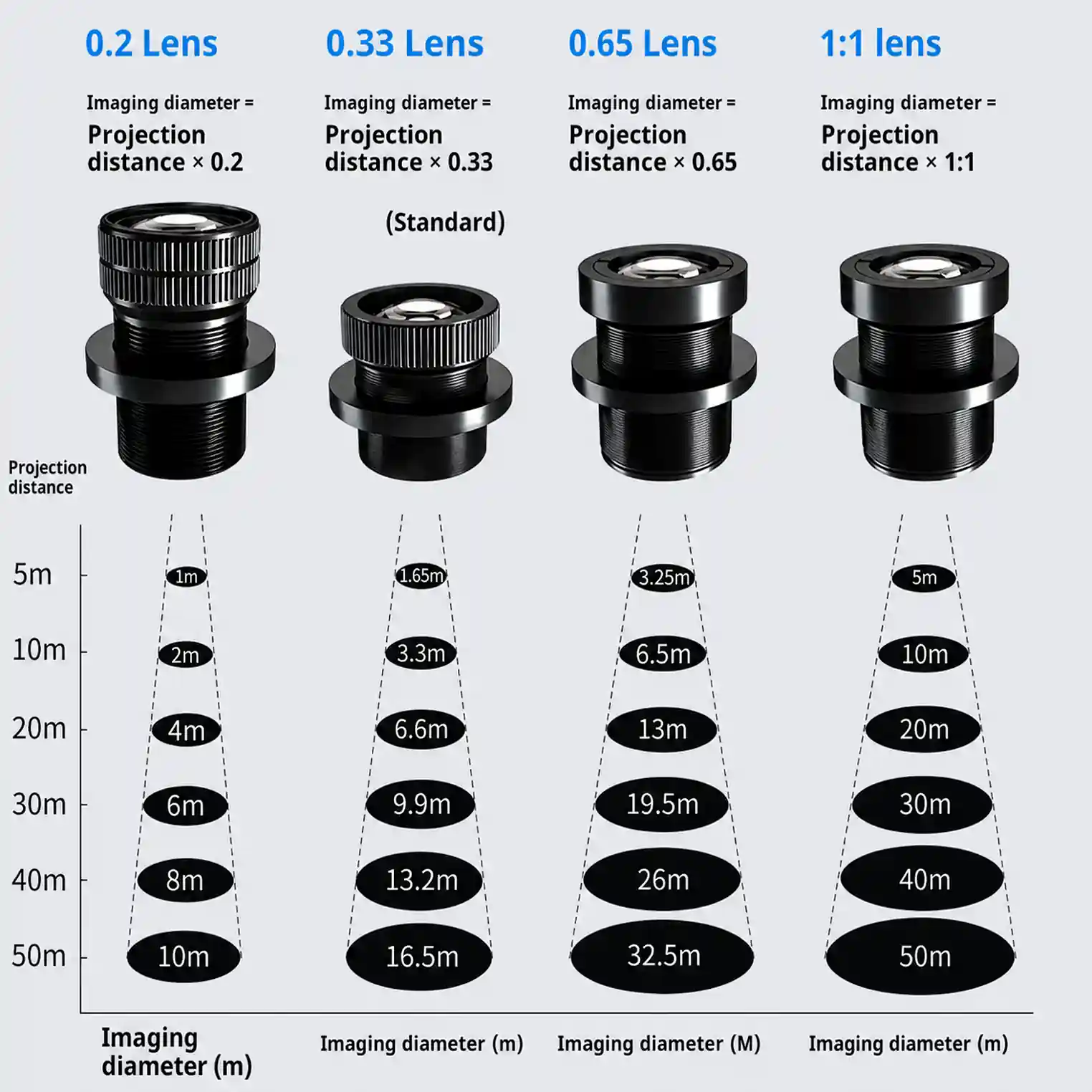
For example, at a 10 m projection distance:
0.2 lens: approximately 2 m image diameter
0.33 lens: approximately 3.3 m image diameter
0.65 lens: approximately 6.5 m image diameter
1:1 lens: approximately 10 m image diameter
For example, if you need a 6.5 m projection diameter at 10 m, a 0.65 lens would be suitable.
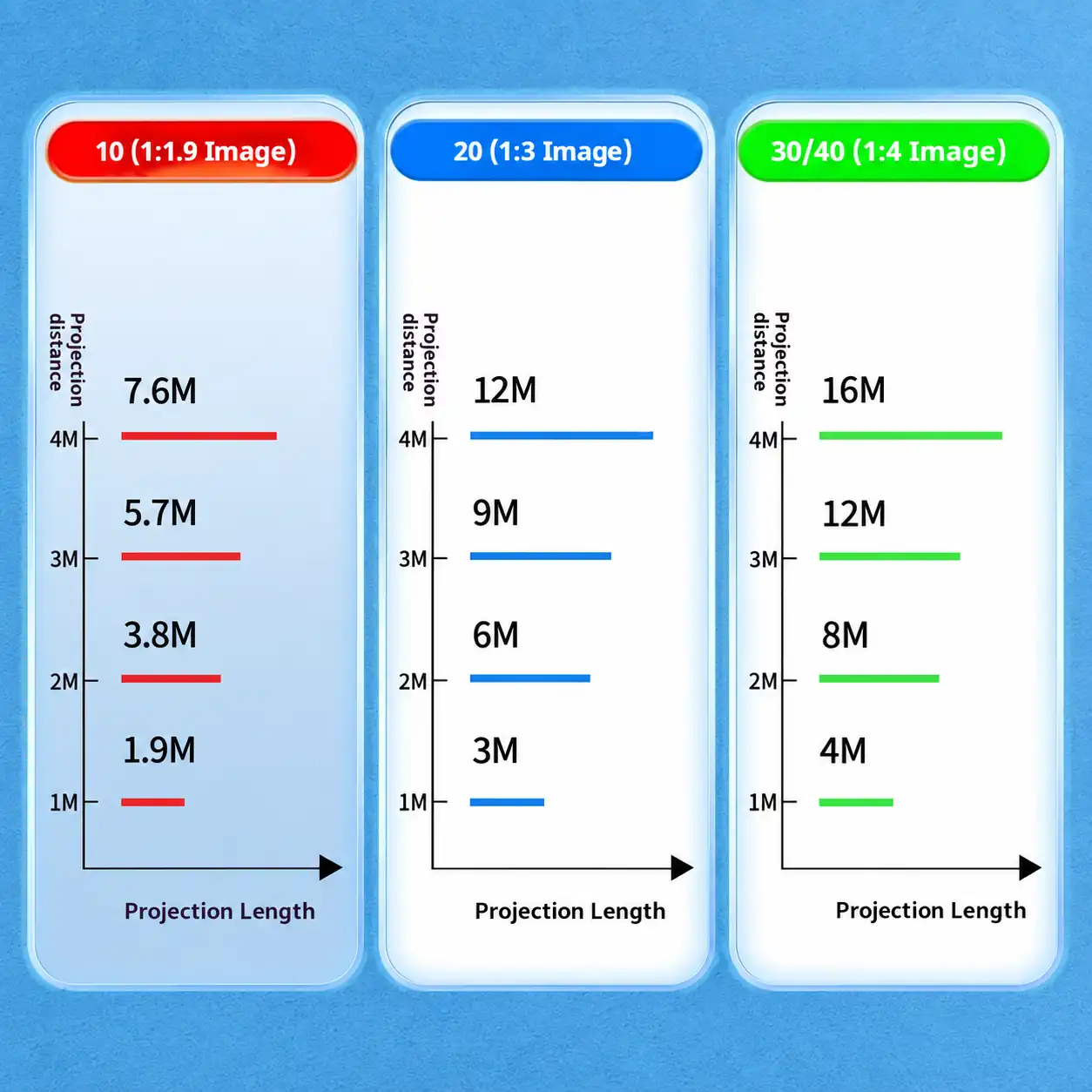
1:1.9: 1 m distance → 1.9 m line; 2 m → 3.8 m; 3 m → 5.7 m; 4 m → 7.6 m
1:3: 1 m distance → 3 m line; 2 m → 6 m; 3 m → 9 m; 4 m → 12 m
1:4: 1 m distance → 4 m line; 2 m → 8 m; 3 m → 12 m; 4 m → 16 m
In general, a wider projection option creates a longer laser safety line at the same installation height or distance. The best configuration should be selected according to the required line length, mounting height, working area, and ambient lighting conditions.The line width is adjustable for red, green, and blue lasers, and optional accessories can be added to adjust the projected line length.
Technical Selection & Operation
More Questions Industrial Buyers Ask
These additional answers cover the selection, installation, control and maintenance topics collected from real buyer enquiries. Exact performance and compatibility are confirmed by model and site conditions.
Will the projection be visible under bright ambient light?
Visibility depends on ambient illuminance, projection distance, image size, surface color and projector output. Indoor factories normally need less output than sunlit outdoor areas. Direct sunlight is the most demanding condition, so send a site photo and, when possible, an illuminance reading before selecting a model.
Should I choose an LED projector or a laser line projector?
Choose an LED or gobo projector for symbols, text, logos, arrows, STOP signs and other shaped graphics. Choose a laser line projector when the task is to create a long, narrow boundary or positioning line. The final choice also depends on distance, ambient light and the required line or image size.
How can I reduce blur, ghosting or image distortion?
Match the lens to the distance and image size, mount the projector securely, aim it as close to perpendicular to the target surface as practical and complete final focus adjustment on site. Uneven floors, steep projection angles and vibration can distort the image even when the projector is working correctly.
How do I adjust the angle and focus?
Use the adjustable bracket to set the projection direction, then use the model’s focus mechanism to sharpen the image. Tighten all bracket fasteners after adjustment. Focus range and adjustment method vary by model, so confirm access requirements before mounting in a high or restricted location.
What projection surface gives the best result?
A flat, matte, light-to-medium colored surface usually provides the most even result. Very dark, glossy, wet, heavily textured or uneven surfaces may reduce contrast or distort the graphic. A site test is recommended when the floor coating or wall finish is unusual.
What should I check if the image is blurry, flickering or not visible?
- Blurry image: recheck distance, lens selection, focus and mounting angle.
- Flicker or no light: isolate power, wiring, control-signal and connector issues.
- Pattern movement: inspect bracket tightness and vibration.
- Overheating: keep ventilation paths clear and verify the installation temperature.
Disconnect power and follow qualified electrical procedures before inspection.
How should heat dissipation be considered for continuous operation?
Leave ventilation space around the housing and heat sink, avoid sealed enclosures unless they are engineered for cooling, and keep dust or oil from blocking airflow. Confirm the model’s rated operating temperature and duty requirements for high-temperature or 24/7 applications.
Can the gobo pattern be replaced or switched automatically?
Replaceable gobos, dual-image switching, multi-image rotation and sensor-triggered changes are available on selected configurations. Provide vector artwork such as AI, PDF, SVG or EPS when possible; high-resolution PNG or JPG files can be reviewed when vector artwork is unavailable.
Can multiple projectors be synchronized or controlled as a group?
Selected custom systems can support shared triggers, grouped switching or linkage with external controls. The required I/O, communication method, cable distance, switching sequence and safe-state behavior must be defined before the controller is selected.
Are sensing, timing, dimming and remote-control functions available?
Depending on the model, options may include limit switches, infrared sensing, project-reviewed camera recognition, scheduled operation, brightness control, wireless remote control and external automation signals. Confirm which functions are standard and which require a custom control module.
What maintenance is normally required?
Periodically clean the lens and heat-dissipation surfaces, check bracket fasteners, inspect cables and connectors, and confirm focus and warning alignment. Maintenance frequency should be increased in dusty, oily, vibrating, wet or high-temperature environments.
How are warranty, spare parts and laser safety confirmed?
Warranty terms, replacement parts, ingress protection and laser classification vary by product family and destination market. Request the exact model datasheet, quotation terms and applicable compliance documents before purchase. Never assume that one rating applies to every projector.
For an accurate recommendation: send the application, installation height, projection distance, target image or line size, ambient-light conditions, surface color, supply voltage, mounting method, quantity and destination country through our contact page.