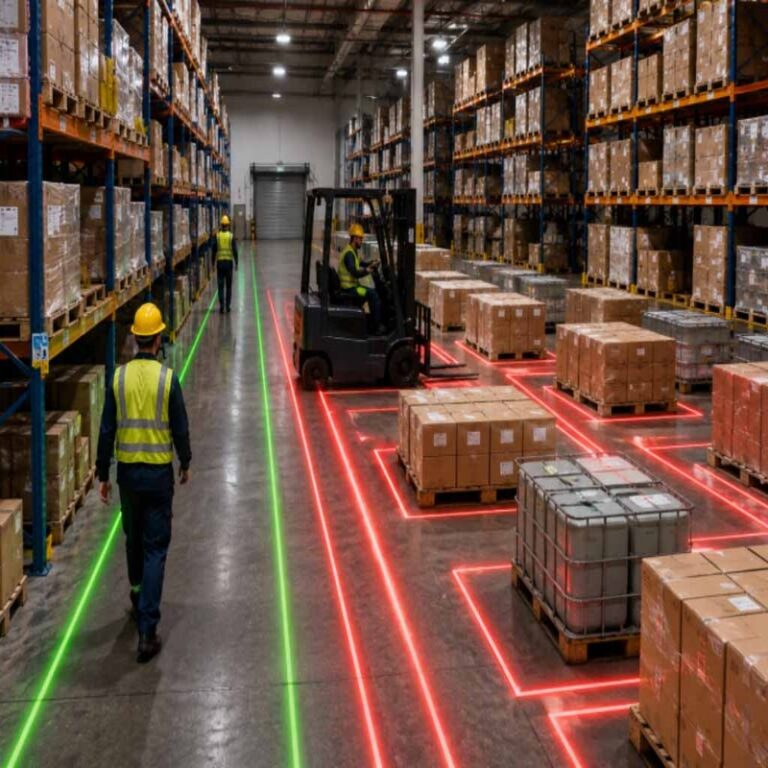

Forklifts are used every day in logistics centers to move pallets, load trucks, and transfer goods between storage areas. They improve work speed, but they also create safety risks. In busy warehouses, forklifts often move through narrow aisles, rack areas, loading zones, and blind corners. Workers may not always see a forklift coming, especially when shelves, pallets, walls, or other equipment block the view.
A forklift warning projection system gives workers an earlier visual warning. By installing a projector light on the forklift, the system can project a clear STOP sign, WARNING sign, or custom safety symbol onto the floor. The warning can appear several meters in front of or behind the forklift, helping people notice the vehicle before it reaches them.
For logistics centers with frequent forklift traffic, this simple visual warning can improve daily safety without changing the warehouse floor.Forklift drivers do not always have a full view around the vehicle. Large loads can block the driver’s forward view, while high racks and stacked pallets can create blind areas at intersections.At the same time, warehouse workers may be focused on picking, packing, scanning, or moving goods. In a noisy logistics center, they may not notice a forklift until it is already close.
Traditional warning methods such as horns, floor paint, mirrors, and safety signs are still useful, but they have limits. Floor markings stay in one place, while forklifts are always moving. A horn can also be difficult to locate in a noisy area.A forklift warning projection moves together with the forklift. This means the safety warning is always connected to the moving vehicle.
One common solution is to install the projector on the front of the forklift.The projector can display a bright STOP sign, WARNING symbol, forklift icon, or another safety pattern on the floor. The projection distance can normally be set according to the warehouse layout. For many applications, a warning area around 1 to 5 meters in front of the forklift is practical.When a worker sees the projected sign moving toward an aisle or crossing area, they can understand that a forklift is approaching. This gives the worker more time to stop, move to the side, or wait for the forklift to pass.
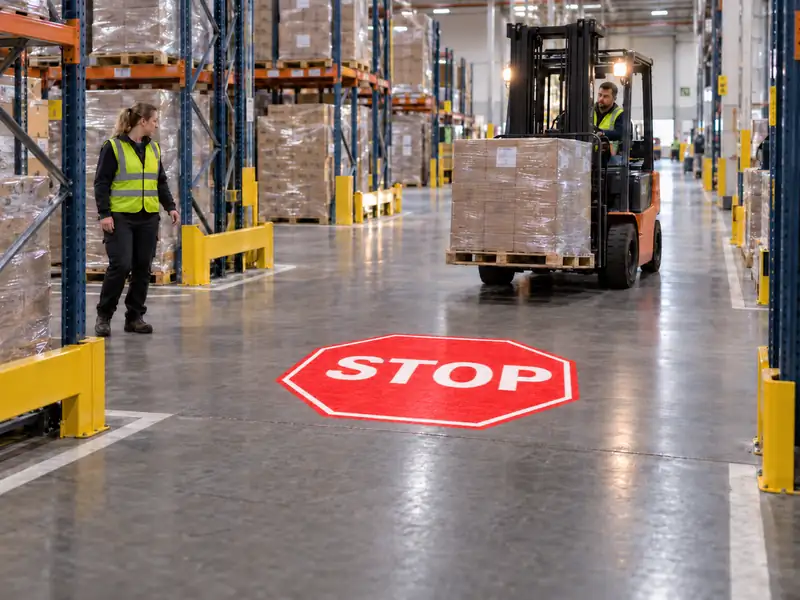
Unlike a fixed floor sign, the forklift warning projection travels with the vehicle. It creates a moving safety message that clearly shows where the forklift is heading.This is especially useful near warehouse intersections, picking areas, loading zones, high rack aisles, packing stations, doors, and narrow passages.A forklift projector light can also use different warning patterns based on the site’s safety rules. For example, one warehouse may use a red STOP sign, while another may prefer a yellow WARNING symbol.
Forklift safety is not only about forward movement. Reversing is another common risk in logistics centers.A driver may have limited visibility behind the forklift, especially when working in crowded areas. Workers may also walk behind the vehicle without realizing that it is about to reverse.Installing a second forklift warning projection system on the rear of the forklift can provide an extra warning.When the forklift moves backward, a projected STOP or WARNING sign can appear on the floor behind it. Workers can see the warning area before the forklift gets close and move away from the reversing path.This is useful in loading docks, pallet storage zones, sorting areas, and other places where forklifts often need to move forward and backward.Compared with fixed forklift traffic lights, a moving projection can stay with the forklift and show the warning exactly where the vehicle is operating.
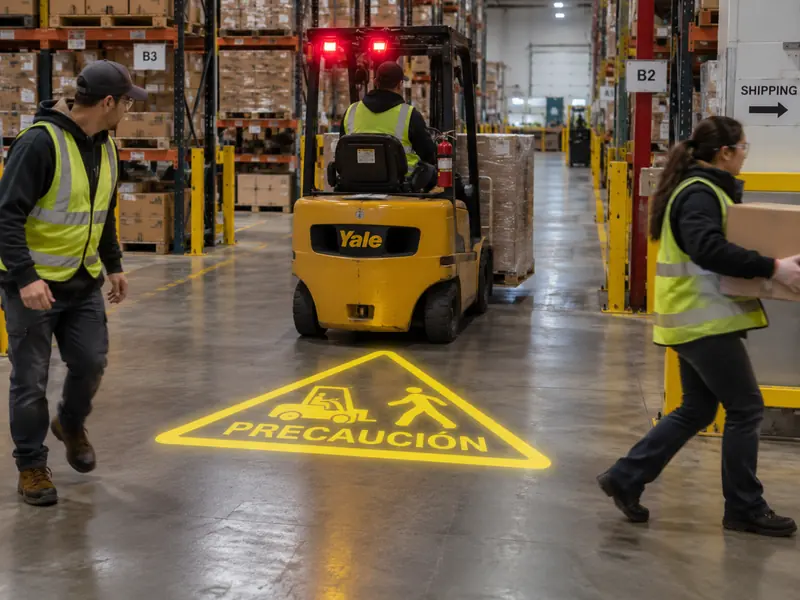
Visual projection can also work together with a sensing system.For example, a sensor can be installed on the forklift to detect a person entering a set safety distance. When someone comes too close, the system can activate an audible alarm.This creates two types of warning at the same time: the worker can see the projected safety sign, while the forklift driver can hear the alarm.This gives both sides more time to react. The worker can step away from the forklift route, and the driver can slow down or stop before the distance becomes dangerous.A forklift warning projection combined with a sensing alarm is especially useful in areas with many workers, frequent crossing traffic, and limited visibility.
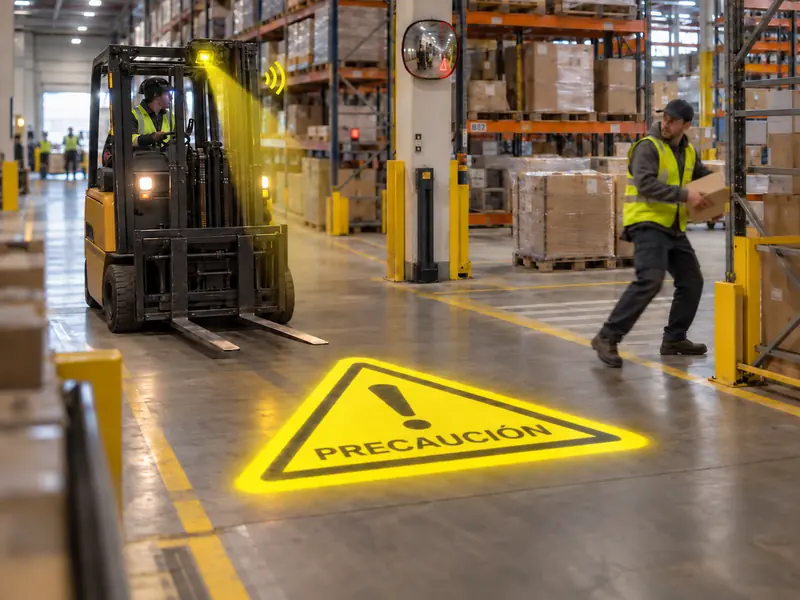
Logistics centers usually have continuous vehicle movement. Forklifts travel between receiving areas, storage racks, picking zones, packing areas, and loading docks throughout the day.Because traffic routes change with daily work, fixed floor warnings cannot always show the real position of a moving forklift.A forklift warning projection creates a warning directly around the vehicle. It does not require painting new signs every time the warehouse layout changes.It can also help managers improve safety without adding large physical barriers that may affect forklift movement.For facilities with several forklifts, the same type of warning pattern can be used across the fleet. This gives workers a more consistent visual safety signal.