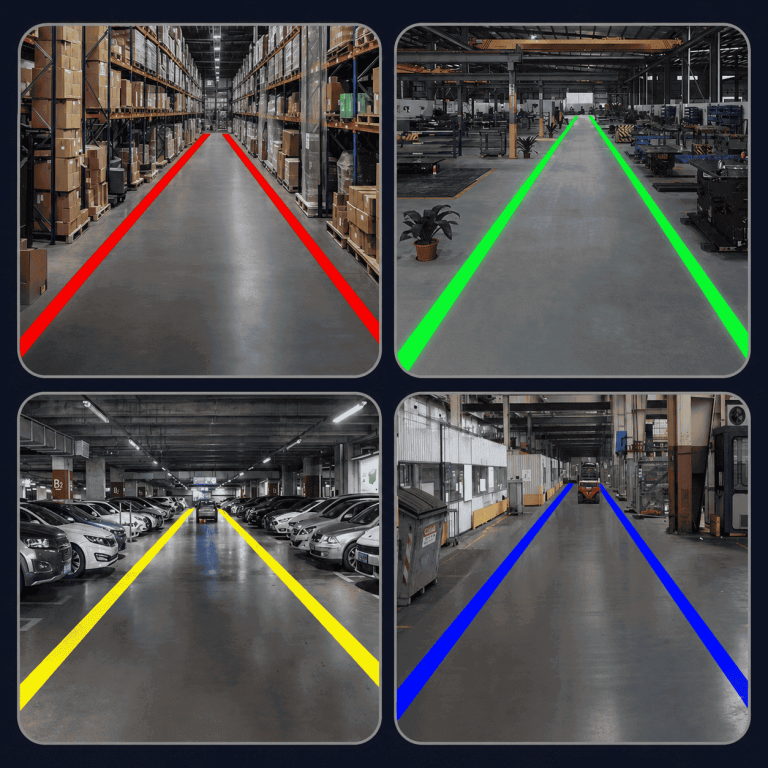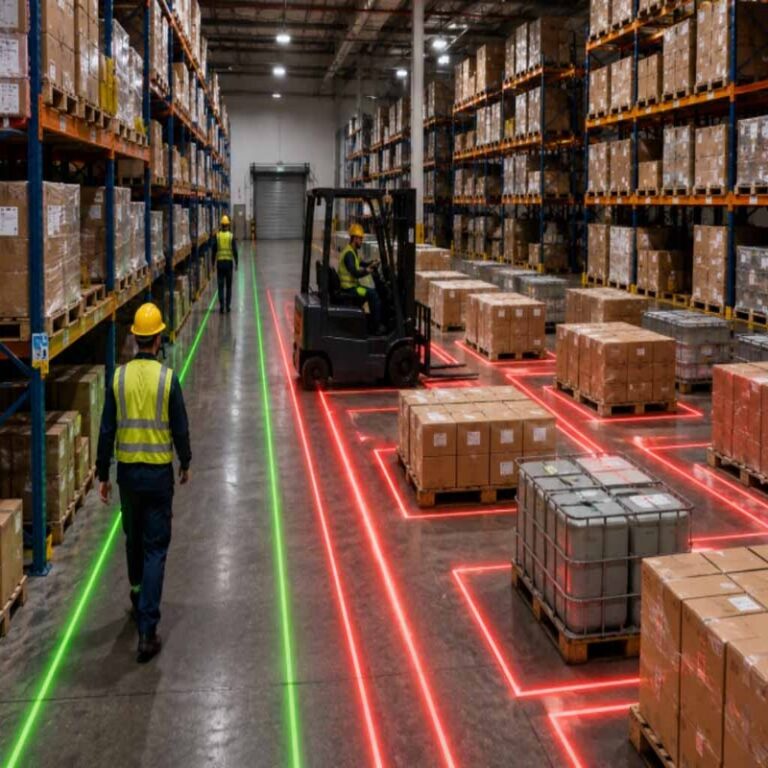

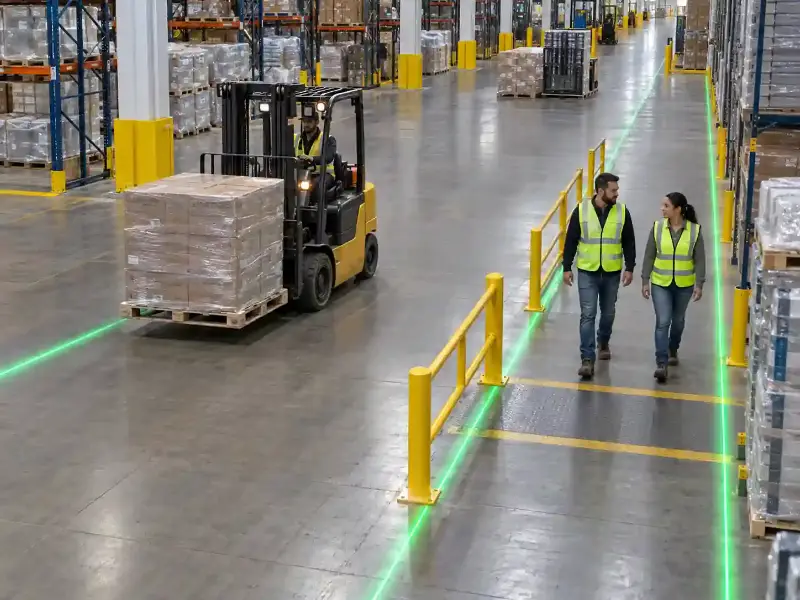
In busy warehouses and factories, painted floor lines fade under constant forklift and foot traffic, floor tape peels and lifts, and static wall signs are easily overlooked. When pedestrian walkways and vehicle routes are no longer clear, the risk of confusion and near misses between forklifts and people on foot increases. A green line projector offers a practical alternative, projecting bright, clearly defined lines and warning signs directly onto the floor. As virtual signage, it remains visible without the wear, damage, or frequent repainting associated with physical markings, helping facilities maintain clearer routes, safer crossings, and better separation between pedestrians and moving equipment.
How a Green Line Projector Works
A green line projector is mounted above the area to be marked, on a ceiling, column, rack or wall bracket, and uses a light source and optics to cast a green line onto the floor below. The projected line forms a virtual boundary without contact with the surface, so it is not worn away by forklift traffic, pallet dragging or cleaning.
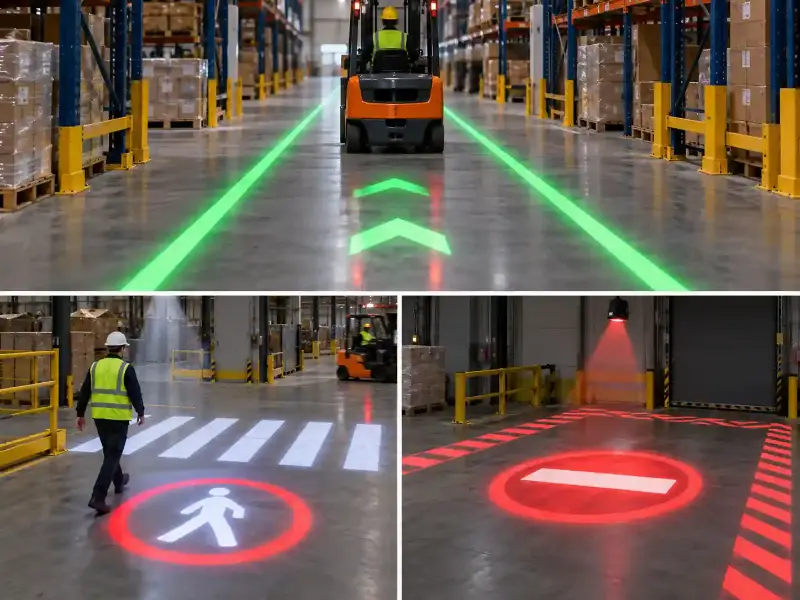
In practice, managers use the line to define pedestrian routes, mark the edge of forklift operating areas, outline loading or staging zones, and highlight crossing points and aisle entries. Positioned differently, a projector can also cast the line onto a wall where a floor mark would be obscured. Because the boundary is light rather than paint or tape, its position can be adjusted by repositioning or re-aiming the projector when layouts change.
Visibility depends on ambient lighting, floor colour and finish, mounting position and obstructions, so buyers should test the intended location and confirm specifications against their own site conditions before wider installation.
Where Green Line Projection Helps Most
A green line projector for warehouse safety is most useful where traffic routes are fixed but floor markings wear quickly. In warehouses, projected lines can define pedestrian walkways along racking aisles, mark staging and storage boundaries, and highlight crossings at aisle ends where forklifts emerge with limited visibility. As an industrial line projector for pedestrian walkways, it helps separate foot traffic from vehicle routes without relying on paint or tape that can fade, peel, or be obscured by dust, pallets, and routine cleaning.
In factories, projection suits workcell boundaries, machine-adjacent exclusion areas, and routes that may need review as layouts change. At loading docks, lines can mark dock edges, trailer staging areas, pedestrian waiting points, and no-go zones around reversing vehicles. It is also valuable at blind corners, intersections, shared doorways, and other forklift and pedestrian conflict points.
Before specifying, map those conflict points, confirm sight lines from operator and pedestrian positions, and check that the projected line remains clear under your site’s lighting, floor surface, and traffic conditions.
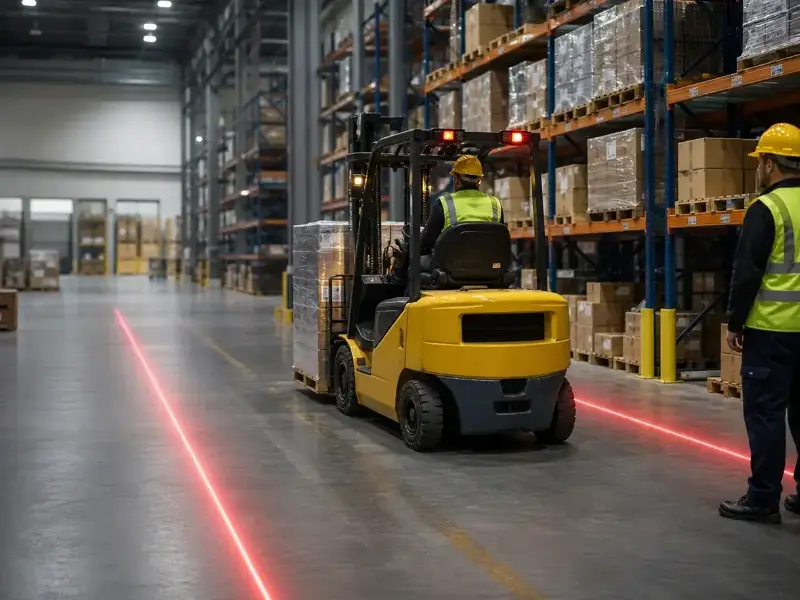
Visibility in Bright and Dusty Environments
In a working warehouse, a projected line is only useful if operators and pedestrians can see it clearly from their normal positions. Ambient lighting is a key variable: strong daylight from dock doors, skylights, or open loading areas can reduce contrast, while artificial lighting can differ by zone. Dust from pallets, packaging, and vehicle traffic can settle on floors and lenses, softening edges if cleaning and inspection are not part of routine maintenance.
Floor finish also matters. Light, dark, polished, worn, or marked concrete will reflect and absorb light differently, and wet or oily areas may change appearance during a shift. Viewing distance and angle affect perceived sharpness as well, particularly where forklift drivers view the floor from a raised, moving position.
Before selecting a green line projector, test the projected line in the actual aisle, walkway, or loading area, at different times of day and under normal operating conditions. Confirm specifications, mounting position, and expected clarity with the supplier against those site conditions rather than relying on showroom results.
Installation and Placement Considerations
Start by surveying the aisle, walkway, or crossing where the line will be used, noting existing racking, lighting, traffic flow, and any obstructions that could cast shadows or block the projection. Mount an industrial line projector for pedestrian walkways on a stable, vibration-free surface overhead or on a suitable wall or column, positioned to project directly onto the intended boundary without interfering with forklift masts, stored goods, or overhead operations.
Projection angle affects line straightness, width, and clarity, so adjust it during commissioning and check the result from pedestrian and driver viewpoints at different times of day. Align the line precisely with the edge of the walkway, exclusion zone, or traffic lane it defines, and recheck alignment after any layout change.
Finally, confirm safe, accessible power access and cable routing that avoids trip hazards and vehicle damage, and confirm specifications against your own site conditions before final installation.
How to Choose the Right Setup for Your Site
Start by mapping the area you need to mark, including its length, width, ceiling or mounting height, and any obstructions such as racking, machinery, or stacked goods that could block the projection. Next, review traffic flow: note where forklifts turn, reverse, load, and cross pedestrian routes, and where people enter or exit the zone. This helps decide whether you need a single continuous line, paired lines for a walkway, or stop lines and boundaries at intersections.
Then assess floor conditions. Consider surface colour and texture, existing paint or tape, exposure to dust, moisture, or frequent cleaning, and how ambient light changes across shifts. A green safety line projector for forklift zones will perform differently on dark, worn, or reflective concrete than on a clean, light surface.
Finally, sketch the required line layout, photograph the site, and share measurements with your supplier to confirm specifications against your own site conditions before selecting a green line projector for warehouse safety.
Maintenance Compared With Paint and Floor Tape
Painted lines and floor tape sit in the traffic path, so forklift tyres, dragged pallets and scrubbing scuff, chip and fade them. Restoring legibility is rarely a touch-up: crews must clean and prepare the surface, reapply paint or tape, remove adhesive residue or loose edges, and keep the area out of use while paint dries or tape beds in. In high-traffic zones, that work recurs, and markings can become inconsistent between repairs.
A green line projector avoids contact wear because the marking is light projected from above, not a coating on the concrete. Routine upkeep shifts to checks: wipe dust from the lens, confirm the mounting remains secure and aligned, and verify the line falls correctly after racking or layout changes. As a virtual green floor marking projector, it can also serve as an industrial line projector for pedestrian walkways without surface preparation or curing time when routes move. Managers should inspect visibility under their lighting, dust and cleaning conditions, and include checks in the maintenance schedule.
FAQ
Will a green line projector remain visible in a brightly lit warehouse?
Visibility depends on ambient lighting, floor colour and finish, and mounting height and angle, so performance will vary between sites. Green is commonly selected for floor marking because it stands out clearly against many warehouse floors and is readily associated with designated walkways and safe routes. Before a full rollout, test a green line projector for warehouse safety in the actual location and confirm the specifications against your own site conditions.
How is a virtual green floor marking projector installed, and can the marking be changed later?
It is typically mounted overhead on a ceiling, wall, or column and aimed at the floor area where the line is needed, with power and alignment confirmed during commissioning. Because the marking is projected rather than painted, the layout can usually be adjusted by repositioning or re-aiming the unit, or by changing the projected pattern where the setup allows.
Will an industrial line projector for pedestrian walkways withstand daily warehouse use?
Units intended for industrial use are generally built for operation in warehouse environments, but suitability depends on exposure to dust, moisture, vibration, and accidental impact at the mounting location. Choose a protected mounting position, follow the manufacturer’s maintenance guidance, and confirm the enclosure and durability specifications suit your site before ordering.
How do I choose the right green safety line projector for forklift zones?
Start by mapping forklift and pedestrian traffic, the exact start and end points of each line, available mounting positions, and any obstructions that could block the projection. Also consider floor surface and lighting, whether a continuous line, boundary, or additional warning symbol is needed, and how the line should interact with existing signage. Sharing a site plan and photos with the supplier will help you confirm a suitable setup rather than selecting on projector specifications alone.
A green line projector can provide a clear, durable alternative to paint and floor tape, but the right choice depends on your site. Review where lines are needed — pedestrian walkways, forklift routes, loading areas and intersections — and consider floor surface, ambient lighting, mounting position and viewing distance. Also consider how easily markings may need to change as layouts evolve, and the maintenance effort you want to avoid. Confirm specifications against your own site conditions before ordering. To compare suitable options for your facility, view the WarningProjector LED line projector product page or request a quote based on your site requirements.