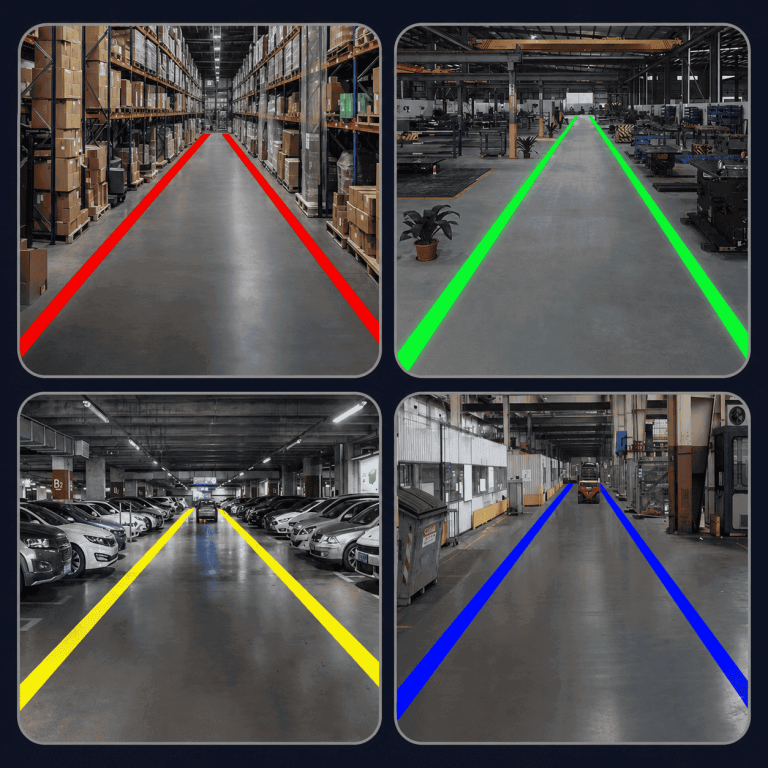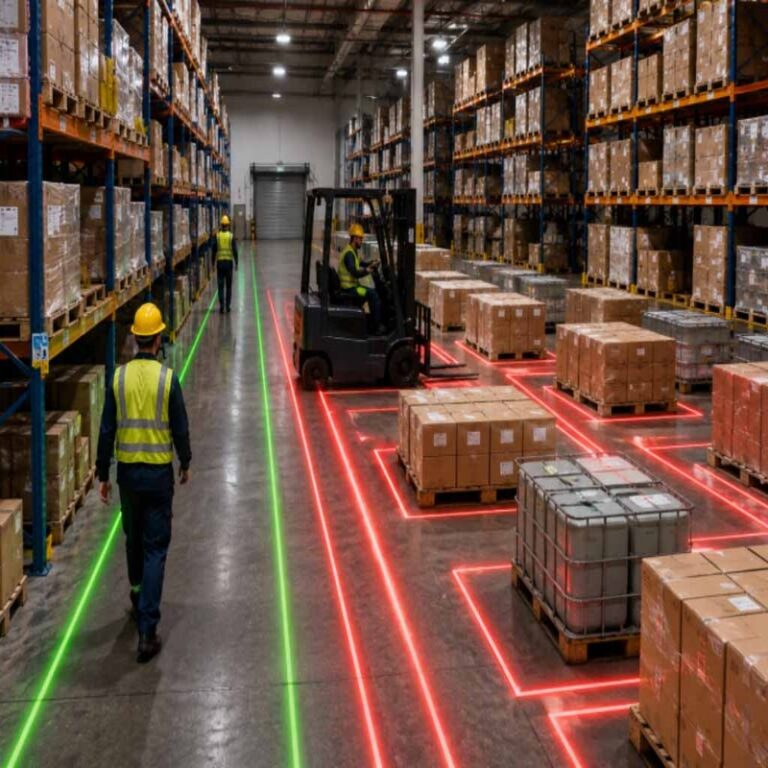

A busy warehouse can have clear traffic rules, marked aisles, and pedestrian walkways, but visibility can still become a problem. Forklifts move between storage racks, workers cross aisles, and pallets may block the view at key points. In these areas, a warning that can be seen directly on the floor can be more useful than a sign placed several meters away.
This is where forklift warning projection can provide a practical visual safety solution. Instead of relying only on painted lines or fixed signs, a projector can place a warning symbol, STOP sign, forklift graphic, or other safety message directly onto the floor or wall. The projection can be positioned close to the area where forklift and pedestrian traffic meet. Industry suppliers currently describe these systems for warehouse aisles, pedestrian crossings, blind corners, intersections, loading areas, and other industrial traffic zones.
Warehouse aisles are one of the most common places where forklifts and pedestrians need to share space. A long aisle may look safe when viewed from one direction, but the situation changes when a forklift turns around a rack or enters an intersection.
A forklift warning projector can create a visual warning before the vehicle reaches a high-risk point. For example, a yellow CAUTION symbol can be projected near an aisle intersection, while a STOP symbol can be placed before a blind corner. A projected pedestrian crossing can also help identify where employees should cross the forklift route.
The advantage is flexibility. If the warehouse layout changes, projected graphics can usually be changed without removing painted floor markings or installing new signs. This is especially useful for facilities that frequently adjust storage areas, production routes, or material-handling paths.
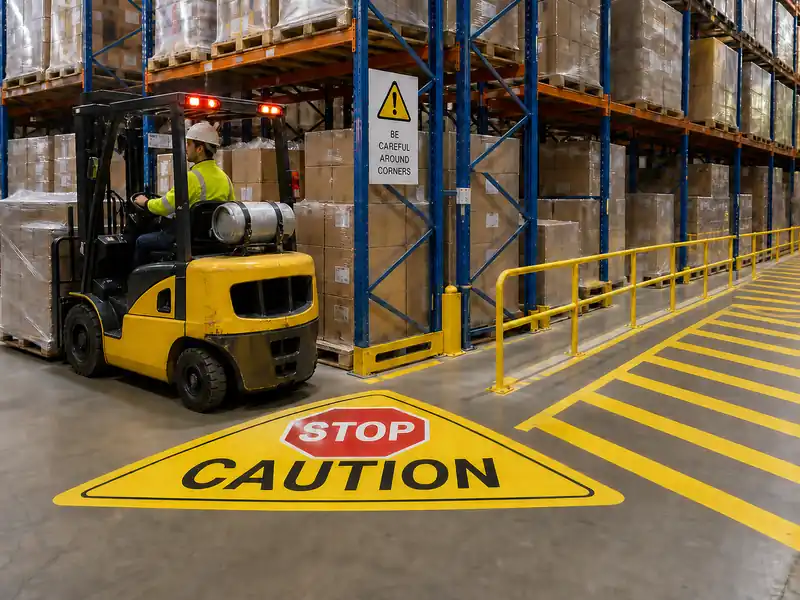
Blind corners are another useful application for forklift warning projection. Racks, stacked products, walls, and machinery can prevent forklift drivers and pedestrians from seeing each other early enough.
A projected STOP or CAUTION symbol can create a visual point of attention on the floor before the corner. Sensor-based systems can also activate a warning projector when a forklift approaches a defined area. Some commercial systems are specifically designed for blind corners, two-way intersections, three-way intersections, and pedestrian walkways.
This does not replace warehouse traffic rules or physical safety controls. Instead, projection can work as an additional visual reminder at locations where normal signs or floor markings may not be noticed quickly.
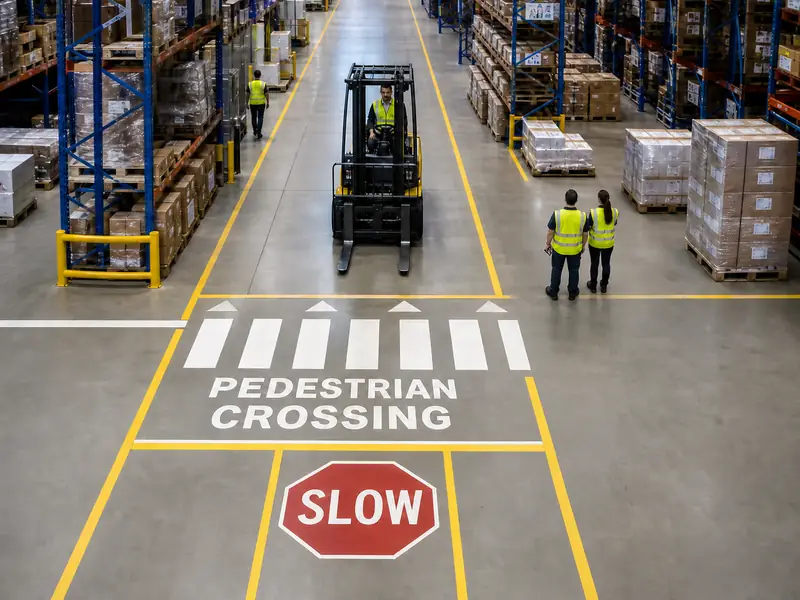
Loading and unloading areas can also benefit from projected safety messages. These areas often have forklifts, trucks, pallets, workers, and temporary storage locations operating at the same time.
A forklift safety projector can mark a warning zone, STOP point, restricted area, or pedestrian crossing. Because the image is projected rather than physically painted on the floor, it is not directly exposed to the same wear caused by forklift wheels, pallet movement, cleaning, and foot traffic. Commercial warehouse projection systems commonly promote this benefit as an alternative to traditional paint and floor tape.
For a facility with several loading doors, projectors can also be installed at specific doors or traffic points according to the actual workflow. This makes it easier to create different safety messages for different areas.
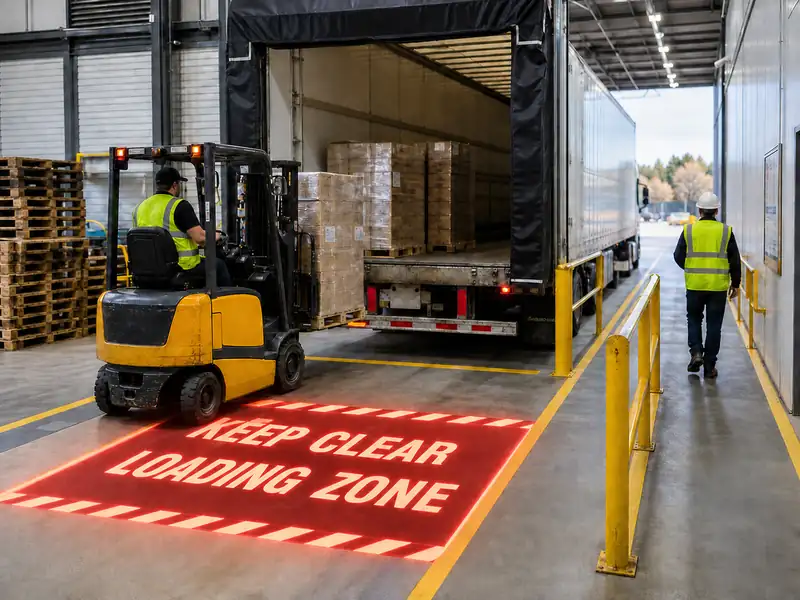
For example, imagine a distribution warehouse where forklifts regularly cross a pedestrian route between two storage areas. The crossing is frequently used during busy shifts, while stacked pallets sometimes reduce visibility from both sides. The warehouse installs a projector above the crossing and displays a bright pedestrian-crossing symbol on the floor. A second warning graphic is placed several meters before the intersection to remind forklift operators to slow down. The result is a clearer visual reference at the point where the two traffic flows meet, without adding another physical sign to the already crowded area.
Not every warehouse needs the same type of projector. The right solution depends on mounting height, projection distance, ambient light, floor color, required image size, and the type of warning that needs to be displayed.
For a simple forklift warning, a fixed symbol or STOP graphic may be enough. For a longer traffic boundary, a laser line projector may be more suitable. For a pedestrian crossing, a wider graphic projection can define the crossing area more clearly. These different approaches are already used in warehouse and industrial safety applications.
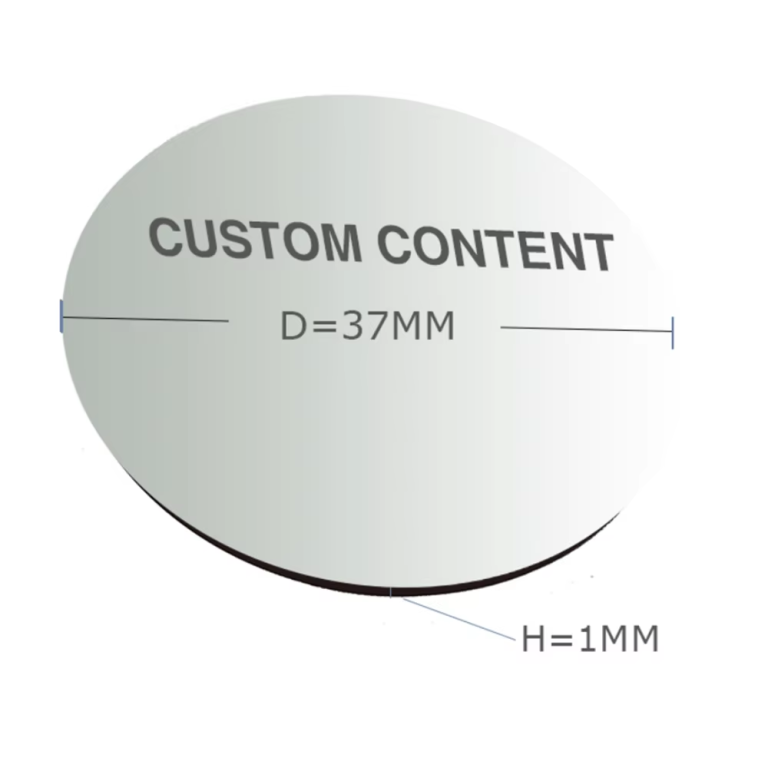
Noparde provides industrial projection solutions that can be configured for different warehouse safety scenarios, including forklift warnings, floor signs, virtual lines, and custom gobo graphics. The best starting point is usually the actual site: mounting height, projection distance, floor condition, ambient light, and the required projection size.
Forklift warning projection is not about replacing every traditional warehouse safety sign. Its value is more specific: it puts a clear visual warning directly where forklift and pedestrian traffic interact.
For warehouse aisles, blind corners, intersections, loading areas, and pedestrian crossings, projection can provide a flexible way to make safety information more visible. When the right projector, brightness, lens, and image size are selected for the environment, the projected warning can become a useful part of a wider warehouse traffic-safety system.
A forklift safety projector can display different types of visual warnings, including STOP signs, CAUTION symbols, forklift warning graphics, pedestrian crossing symbols, directional arrows, safety lines, restricted-area markings, and custom gobo designs.
A forklift warning projector is commonly used in warehouse aisles, forklift intersections, blind corners, pedestrian crossings, loading and unloading areas, production facilities, and other locations where forklifts and pedestrians share traffic space.
Yes. The suitable projector depends on factors such as mounting height, projection distance, ambient light, floor color, and the required projection size. Larger warehouses or higher mounting positions may require higher brightness and a suitable lens to keep the warning image clearly visible.