
In May 2026, a heavy machinery processing workshop in Texas, USA faced a recurring safety management challenge during overhead crane operations.The workshop used a 380V industrial power supply and carried out lifting operations frequently. During daily crane movements, workers could accidentally enter the area beneath suspended loads, creating a serious potential safety hazard.Traditional safety signs and fixed floor markings could not effectively communicate the changing danger zone. The workshop therefore needed a visual warning solution that could work directly with its existing industrial power system and provide a clear warning around suspended loads.
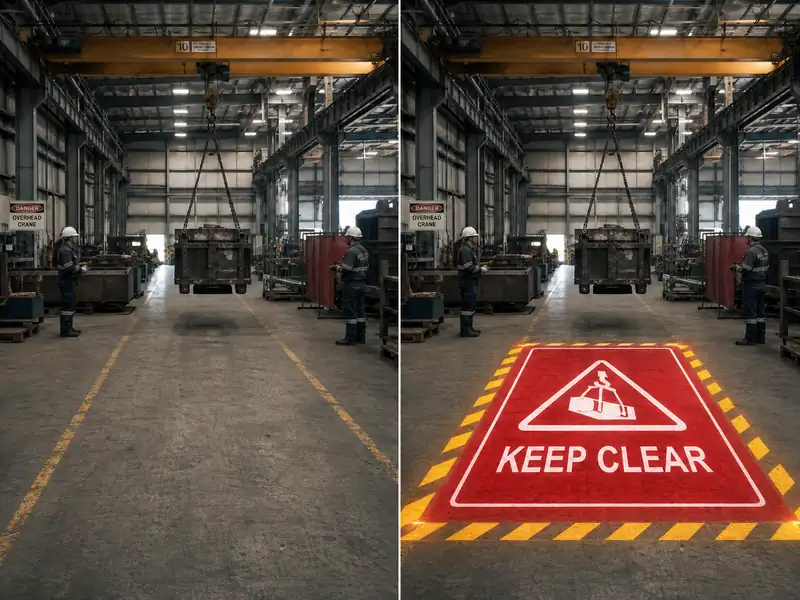
Before the upgrade, the workshop mainly relied on traditional safety signs, painted floor markings, and verbal safety reminders.However, these methods had several limitations.Fixed floor markings only indicated a predetermined area. They could not move with the suspended load as the crane traveled across the workshop.Painted lines could also become less visible because of dust, oil, equipment traffic, and long-term wear. When the workshop layout or crane operating area changed, additional marking work was required.More importantly, a fixed warning could not always attract workers’ attention at the exact location where the lifting operation was taking place.The core problem was therefore not simply a lack of safety signs, but a lack of dynamic visual communication around a moving hazard.
The customer established several specific requirements for the new safety solution.First, the projector needed to work with the workshop’s existing 380V industrial power supply. The customer wanted to avoid adding unnecessary voltage conversion equipment.Second, the projector needed to be installed on the overhead crane steel structure without interfering with normal crane operations.Third, the projection angle needed to be adjustable so that the warning could be accurately directed toward the area beneath the suspended load.Finally, the warning needed to be highly visible and suitable for industrial environments, with customized content such as:“NO STANDING UNDER SUSPENDED LOAD”
The main project requirements were therefore:380V industrial power compatibility,Direct connection to the existing power supply,Crane-mounted installation,Adjustable projection angle,Customized safety warning content,Clear visibility in a busy workshop,Long-term industrial operation,Visual warning of the suspended-load danger zone.
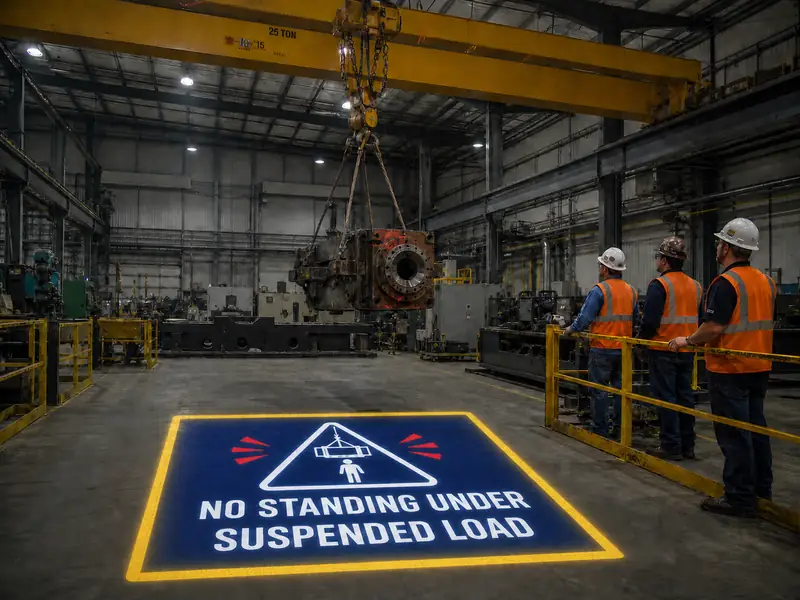
To address these requirements, the workshop installed a Noparde 380V industrial customized safety projector.The projector was designed to work directly with the workshop’s industrial power supply, eliminating the need for an additional step-down device in this application.The unit was mounted on the overhead crane steel frame, with an adjustable projection angle allowing the warning image to be accurately directed toward the area beneath the suspended load.Instead of relying on a fixed painted line, the system projects a customized warning message:“NO STANDING UNDER SUSPENDED LOAD”The projected warning provides a clear visual indication of the lifting danger zone and can be positioned according to the actual crane operating area.As the crane moves and the lifting position changes, the projected warning can provide a more direct visual reference for workers near the operation.
| Feature | Traditional Floor Marking / Signs | 380V Industrial Safety Projector |
| Warning method | Fixed physical marking | Projected visual warning |
| Danger zone | Fixed | Can be adjusted to the lifting area |
| Visibility | Can decline with wear and dirt | Clear projected warning |
| Layout changes | Requires repainting | Adjust projection direction |
| Installation | Requires floor preparation | Crane steel-frame mounting |
| Power integration | Not applicable | Direct 380V industrial power |
| Warning content | Usually fixed | Customized projection content |
| Dynamic operation | Limited | Better suited to moving lifting operations |
| Maintenance | Repainting may be required | Mainly equipment inspection |
The biggest difference is that the projector changes the safety warning from a static physical marking into a flexible visual management tool.
The success of this project depended not only on selecting a projector, but on matching the product to the customer’s actual working conditions.The first consideration was the 380V power supply. Because the workshop already used industrial power, a projector designed for the required voltage simplified the electrical installation and avoided unnecessary conversion equipment.The second consideration was the installation structure. Mounting the projector on the crane steel frame allowed the projection position to be elevated and provided a practical installation point for directing the warning toward the lifting area.The third consideration was projection angle adjustment. Crane operations are not fixed to one position, so the projector needed to allow flexible alignment according to the actual working area.Finally, the warning content was customized specifically for the lifting scenario. Instead of using a generic safety symbol, the projected message directly communicates the key rule:“NO STANDING UNDER SUSPENDED LOAD.”This combination of voltage compatibility + crane mounting + adjustable projection + customized warning content made the solution better suited to the customer’s actual working conditions.
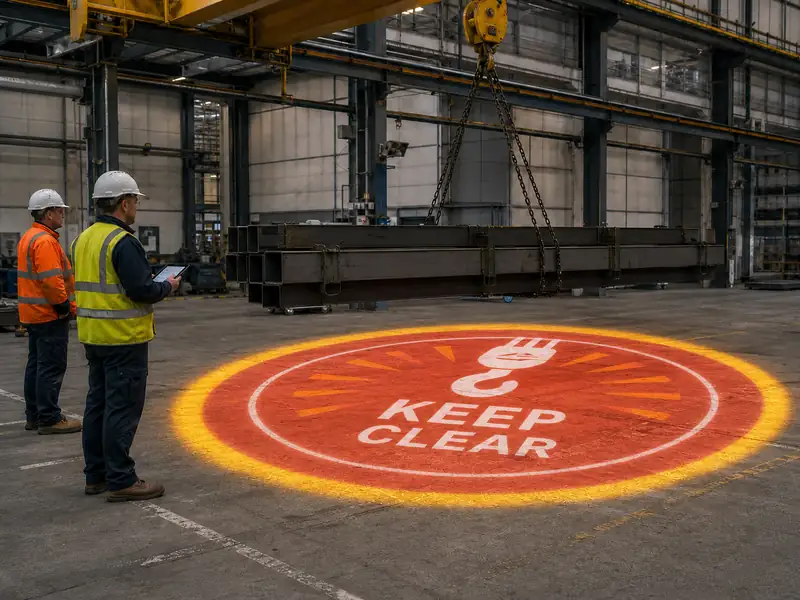
The industrial safety projector is not intended to replace existing safety procedures, operator training, physical barriers, or lifting regulations.Instead, it provides an additional layer of visual safety communication.Traditional safety management tells workers what they should do. A projected warning makes the safety rule more visible at the location where the risk occurs.For overhead crane operations, this is particularly valuable because the hazard area can change as the crane and suspended load move.The projector therefore acts as a visual supplement to existing safety management, helping the workshop create a more noticeable connection between the safety rule and the actual lifting operation.The goal is not simply to add another safety sign.It is to upgrade static safety communication into more flexible visual management.
The Texas heavy machinery workshop demonstrates how a 380V industrial safety projector can be integrated into an overhead crane safety management system.By connecting directly to the required industrial power supply and mounting the projector on the crane steel structure, the workshop created a customized visual warning solution for suspended-load operations.Compared with traditional painted lines and fixed warning signs, projected safety warnings offer greater flexibility for applications where the risk area changes with equipment movement.Similar solutions can be considered for:
- Overhead crane safety
- Suspended-load warning zones
- Heavy machinery workshops
- Factory lifting areas
- Loading and unloading zones
- Warehouse crane operations
- Restricted industrial areas
- Equipment operating zones
The broader value of industrial projection is not simply replacing painted markings. It is providing a more visible, flexible, and customizable layer of safety communication.For industrial facilities using different power systems, mounting structures, projection distances, and warning requirements, the right solution should be selected according to the actual application conditions.This case also demonstrates an important principle for industrial safety: when the hazard moves, the visual warning should be flexible enough to communicate with the changing work environment.A properly configured 380V industrial safety projector can therefore support safer visual management around overhead cranes and other high-risk industrial operations.