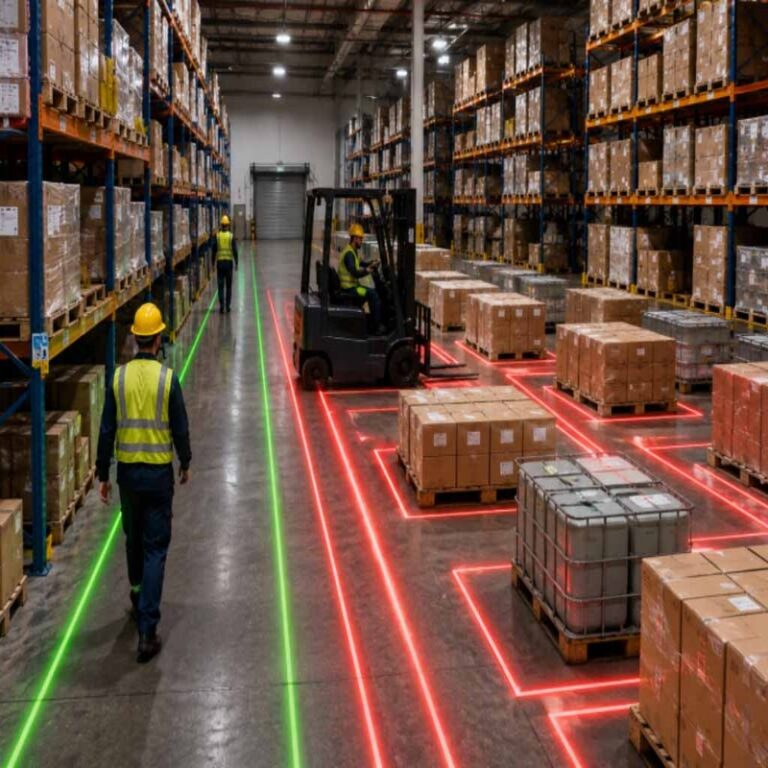

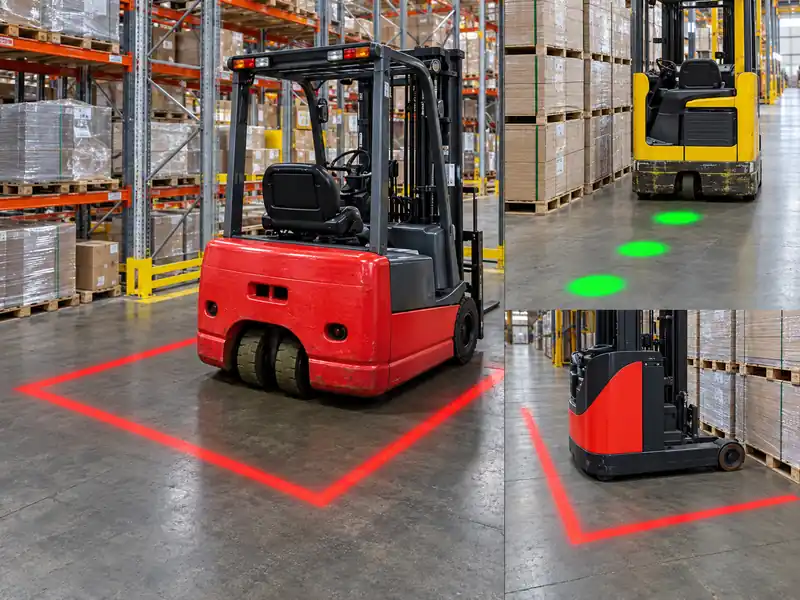
A forklift safety projector light projects a visible line, U-shaped zone, or warning dot onto the floor around a moving forklift. The normal quantity ranges from one to four units. One projector can warn one direction, two can protect the front and rear, and four straight-line units can mark all sides. However, a U-shaped projector can reduce the number of units because one lamp can cover the front and two front-side edges at the same time.The best configuration depends on the forklift body, normal load, travel direction, turning pattern, blind spots, floor condition, and pedestrian routes. More projectors do not automatically make a forklift safer. Workers must be able to understand the projected warning quickly.
Check the Blind Spots First
Before selecting a forklift floor safety projector, load the forklift with the pallet or attachment it normally carries. Then inspect the driver’s view from the front, rear, and both sides. A tall load may block the front, while the counterweight creates a rear blind spot. The mast and cab frame may also affect side visibility.OSHA recommends keeping a clear view, using a spotter for blind spots, sounding the horn at obstructed locations, and separating pedestrians from forklifts where possible. Warning lights can support these measures but cannot replace them.
How Many Projectors Are Normally Needed?
The following table provides a simple starting point. These quantities are common configuration choices rather than legal minimums.
| Projection pattern | Quantity | Coverage |
| One rear straight line | 1 | Rear reversing warning |
| Front and rear straight lines | 2 | Both travel directions |
| Left and right straight lines | 2 | Side safety boundaries |
| Four straight lines | 4 | Front, rear, left, and right |
| One front U-shaped pattern | 1 | Front and two front-side edges |
| Front and rear U-shaped patterns | 2 | U-shaped zones in both directions |
| Three front warning dots | 1 | Forklift approach warning |
| Complex or long forklift | 4–6 | Gaps caused by attachments or body length |
One Projector for a Rear Warning
One forklift floor warning light may be enough when the main danger is behind the forklift. This is common when the truck normally moves forward but must reverse out of storage lanes or loading positions.A rear warning should appear far enough behind the forklift to attract attention before the vehicle arrives. A NIOSH report describes front and rear blue warning lights that project about 15–20 feet, or approximately 4.6–6.1 meters, from the vehicle. However, one rear forklift safety projector light does not cover the front or side-swing area. Use it only when those areas already have clear visibility and effective controls.
Two Projectors for Front and Rear Coverage
Two straight-line projectors are a common choice when a forklift frequently moves in both directions. A front forklift ground projection light warns pedestrians that the truck is approaching, while the rear light warns them during reversing.The front unit must be installed where the normal load will not block it. It may need to sit above or beside the mast, but it must not reduce driver visibility or overhead clearance. Both lights should move and turn with the forklift without shaking or changing position.
Four Straight Lines for Basic All-Side Coverage
A four-unit forklift safety floor projector layout uses one projector at the front, one at the rear, and one on each side. Together, they create a basic rectangular warning area around the vehicle.Side lines are useful because a forklift’s counterweight swings outward during a turn. A pedestrian standing beside the vehicle may appear to be clear of its path but can still be struck by the moving rear section. A forklift safety zone light on each side makes this movement area easier to recognize.Four straight-line units are suitable for busy loading docks, narrow production areas, shared aisles, and locations where pedestrians may approach from several directions.
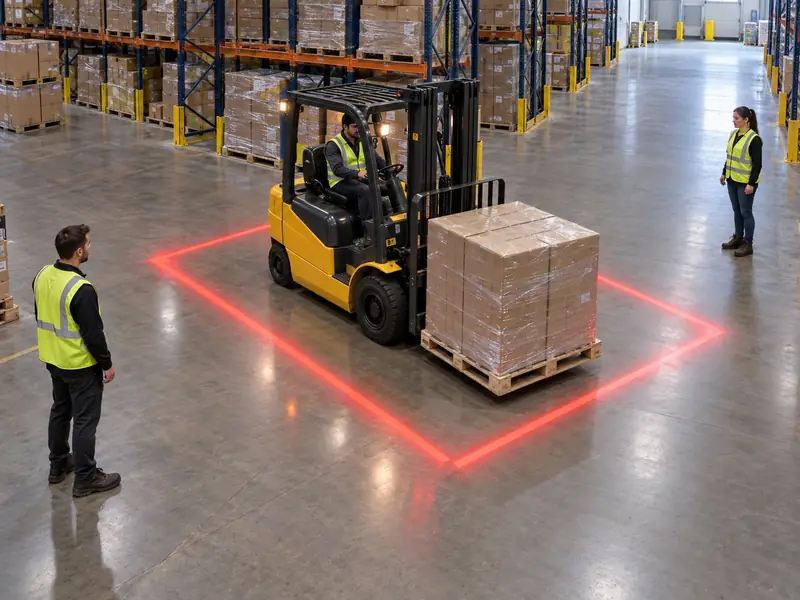
One U-Shaped Projector Can Cover the Front
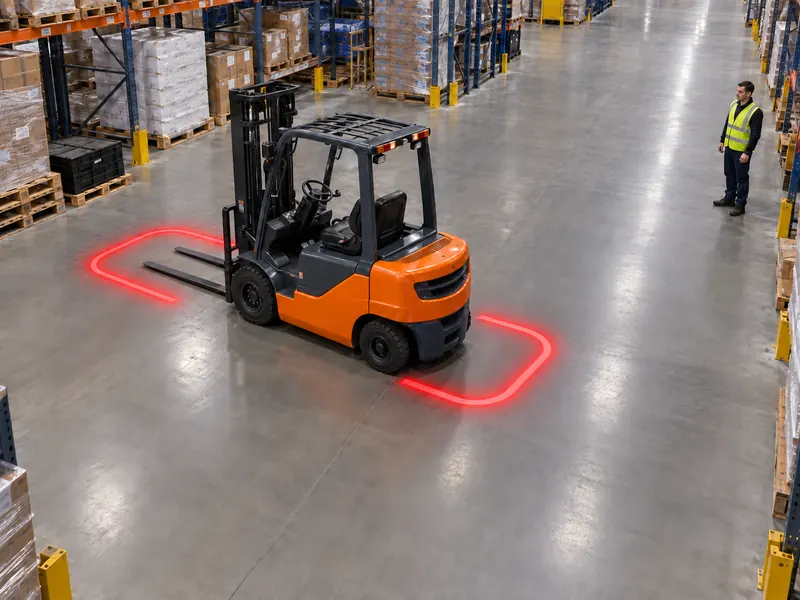
A different option is a forklift safety zone projector that creates one complete U-shaped pattern. One unit can project a front boundary plus two shorter side sections. This allows a single projector to outline the front approach area without installing three separate straight-line lamps.A front U shape is useful when the forklift mainly travels forward. The pattern should be wider than the vehicle and far enough ahead to give pedestrians time to respond. The lamp and lens must be selected for the required U width and projection distance.
One U-shaped forklift safety projector light does not protect the rear. If the forklift frequently reverses, install a second U-shaped unit at the back. One lamp projects a front U and the other projects a rear U, providing warning zones in both travel directions.However, front and rear U shapes may not show the complete rear-swing path during a sharp turn. If pedestrians can approach the middle of the forklift from either side, extra side lines or physical barriers may still be required.
One Projector Can Display Three Warning Dots
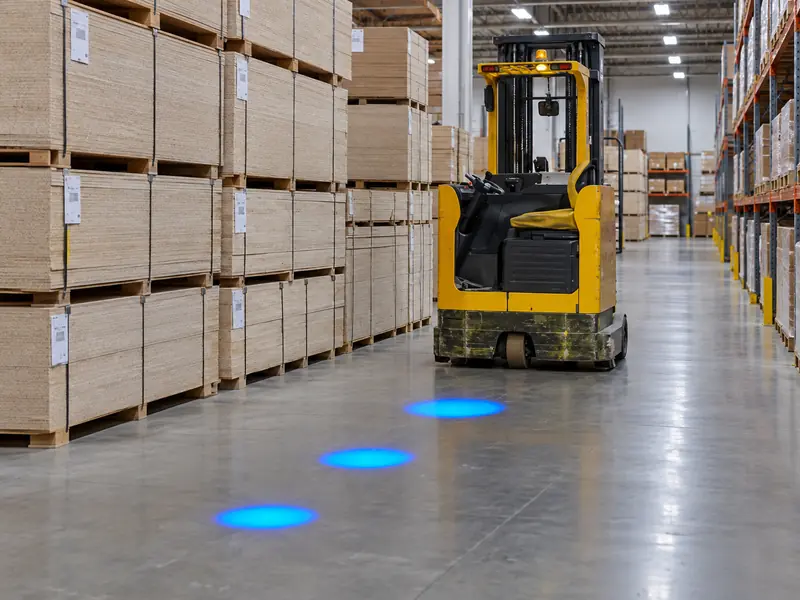
A forklift floor projection safety light can also project three bright dots in front of the forklift. All three dots come from one lamp, so only one unit is needed for a front approach warning.They move with the vehicle and warn pedestrians that a forklift is approaching an intersection, doorway, loading area, or aisle exit.Three dots are usually easier to notice than one small spot, but they do not form a continuous exclusion-zone boundary. This makes them better for approach warning than for showing the full safe distance around a forklift.
How Far Ahead Should the Warning Appear?
Many systems operate at approximately 2–5 meters, but the correct distance depends on vehicle speed, stopping distance, floor condition, ambient light, and pedestrian behavior. A forklift ground safety projector should always be tested on the actual floor.The warning should appear far enough ahead to attract attention but not so far away that workers mistake it for a fixed walkway. Dark concrete, polished floors, water, oil, dust, sunlight, and strong overhead lighting can all change visibility.
Installation and Testing Checklist
Every forklift safety projector light should be checked for:
Forklift voltage compatibility
Secure and vibration-resistant mounting
Protection from dust, water, and impact
Correct projection distance and pattern size
Clear visibility under normal lighting
Safe cable routing
No direct beam toward people’s eyes
No strong reflection from glass or polished metal
No reduction in overhead clearance
Test the system while the forklift is moving, reversing, turning, lifting, carrying its normal load, and passing through doorways. Only authorized personnel should modify the vehicle’s electrical system.
In July 2026, a warehouse tested warning projectors on a forklift working in a shared loading aisle. One rear line left the front and side-swing areas uncovered. The team compared four straight-line units with two U-shaped units. After 30 approach and turning tests with the normal pallet load, both layouts remained visible, but the two U-shaped lights required fewer brackets and cables. Because pedestrians could still approach from the sides, the warehouse retained its barriers, speed limit, horn rules, and marked walkways.
Noparde offers a forklift outline projection product for DC 12–80V systems with a stated projection distance of approximately 2–5 meters. It is a practical option when the voltage, projected shape, color, mounting method, and coverage match the vehicle and worksite. Buyers should request a moving test showing the front, rear, and side coverage before ordering.
One forklift safety projector light is enough for a single rear line, one front U shape, or three warning dots in front. Two units can provide front-and-rear straight lines or U-shaped zones in both directions. Four straight-line units are normally used to mark the front, rear, left, and right sides. Large or unusual forklifts may need more, but the final arrangement must always be confirmed through a site risk assessment and complete visibility test.