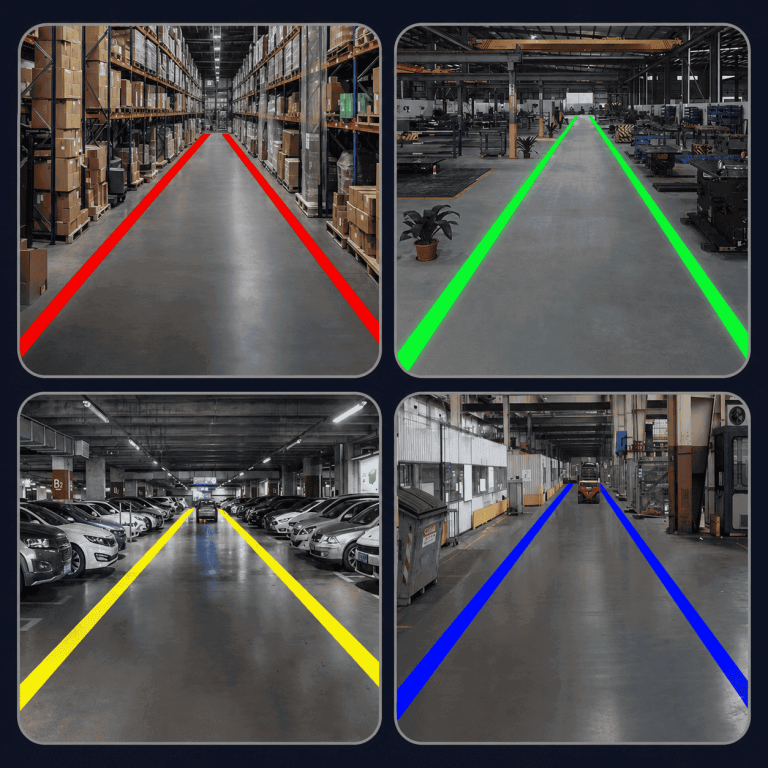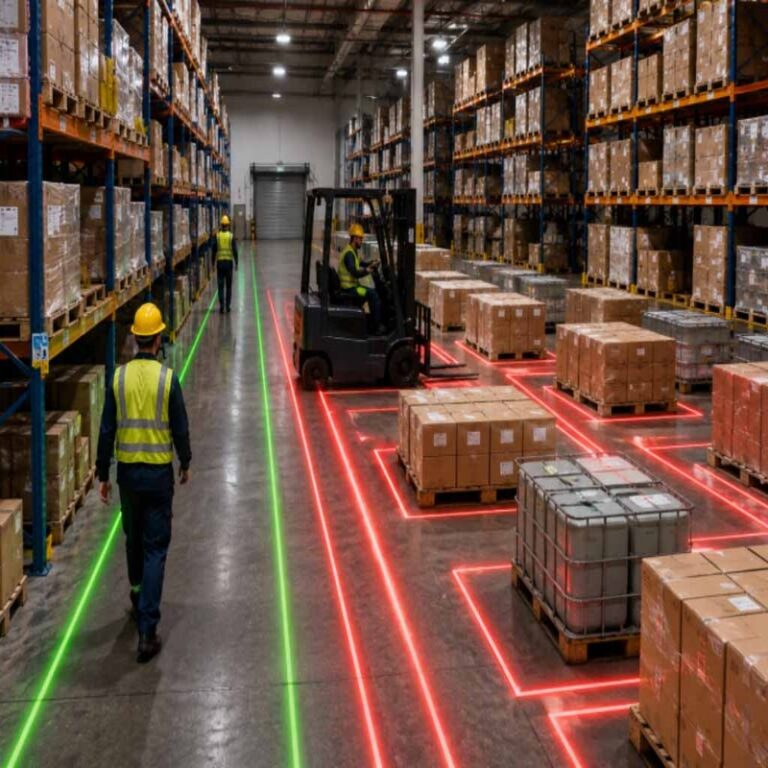

Factories and warehouses are busy places. Forklifts move between shelves, overhead cranes carry heavy loads, and workers often walk close to vehicle routes. Painted lines and floor tape can help guide traffic, but they may fade, become dirty, or require regular replacement. This is why more companies are using safety projectors to create clear warning lines, signs, arrows, and restricted areas.
Choosing the correct projector is not simply a matter of buying the highest wattage. Mounting height, ambient light, projection distance, warning content, control method, and working environment can all affect the final result. This guide explains seven key factors that can help you select the right industrial projector for a factory or warehouse.
1. Define the Safety Problem First
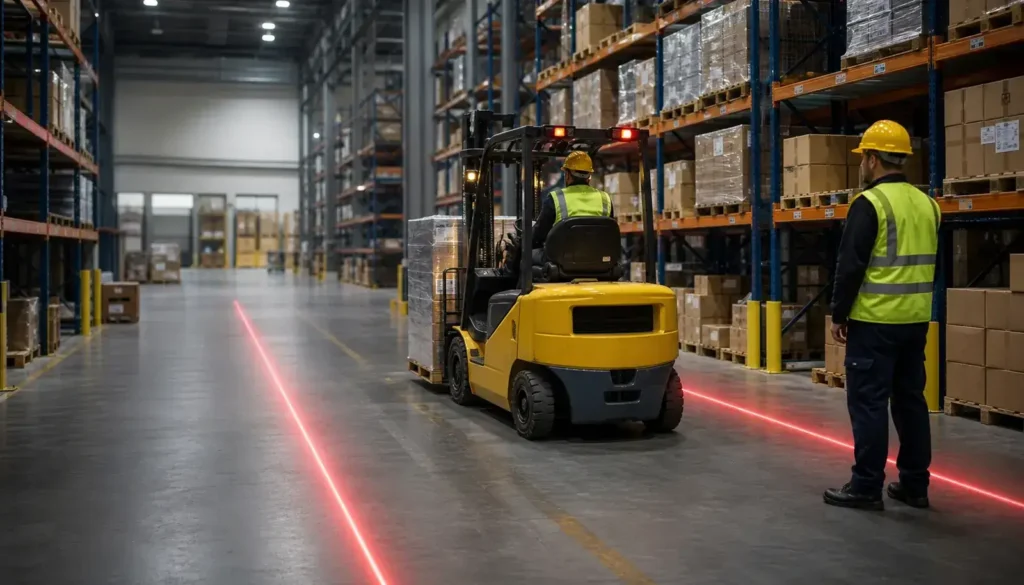
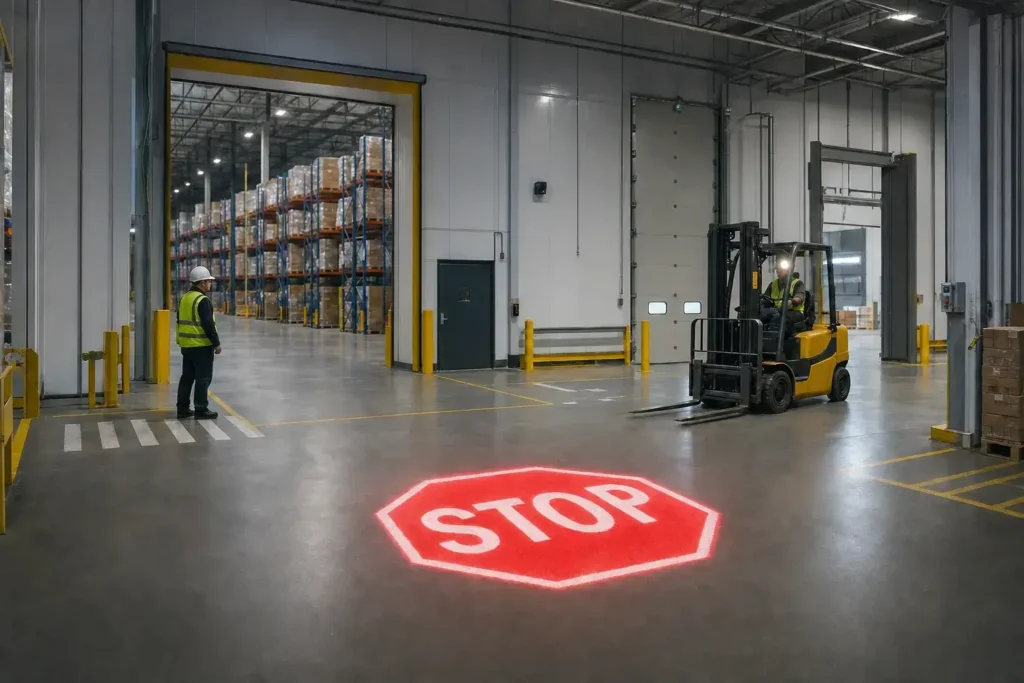
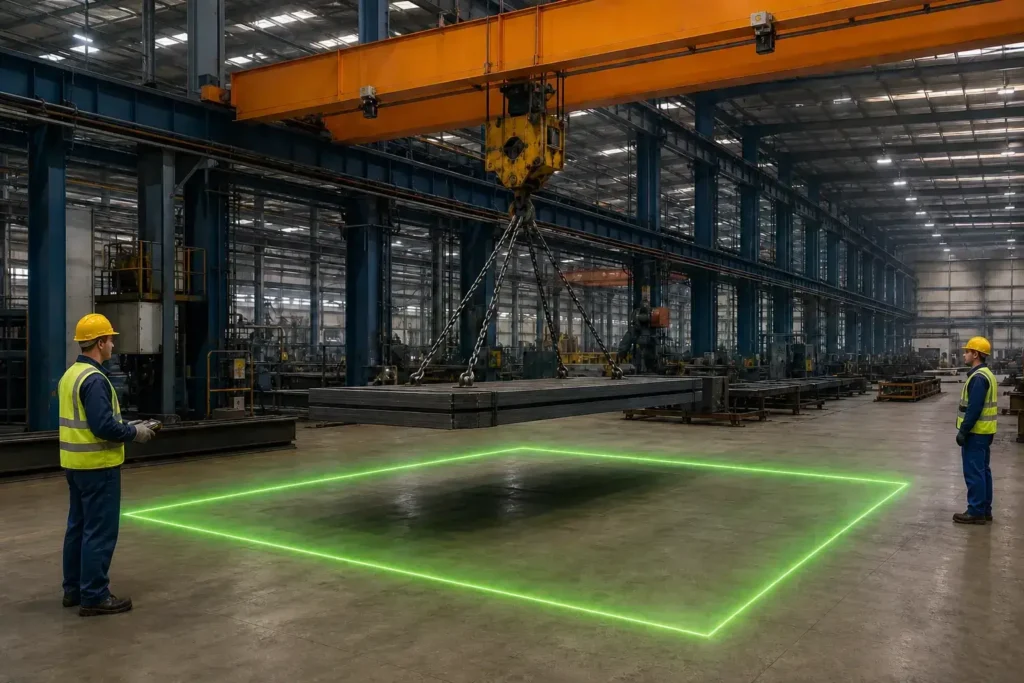
Before comparing different safety projectors, start with the actual problem in the working area. A warehouse may need a pedestrian lane beside a forklift route. A factory may need a STOP sign at a blind corner. An overhead crane may need a warning line to show the danger area below a moving load.
- Pedestrian walkways beside forklift routes
- STOP signs at warehouse doors and blind corners
- Forklift exclusion lines
- Overhead crane safety boundaries
- Loading zones and machine restricted areas
When painted lines become dirty, worn, or covered by dust, projected warnings can provide a bright and flexible visual guide. They can mark pedestrian lanes, forklift routes, loading zones, and temporary restricted areas without changing the floor.
2. Choose Between LED and Laser
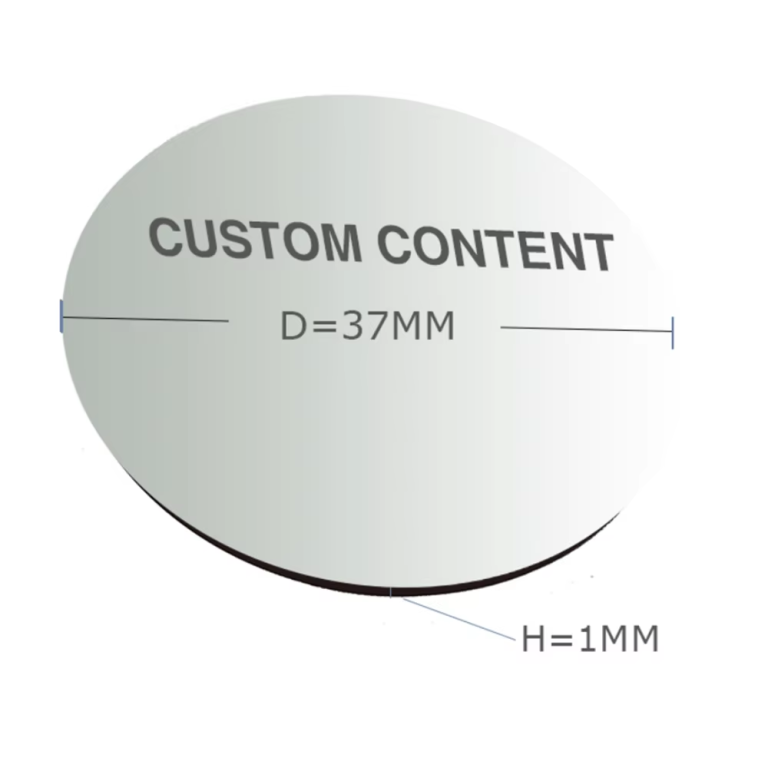
Most safety projectors use either LED or laser technology. An LED sign projector uses a gobo lens to display a fixed image such as a STOP sign, pedestrian symbol, arrow, warning text, company logo, or custom safety pattern.
LED models are often suitable for indoor warehouses, short and medium projection distances, large warning signs, and areas with controlled lighting. An industrial laser projector normally creates straight lines, narrow boundaries, arrows, or other focused marks. Laser light is more concentrated, so it is useful for longer distances, higher mounting positions, crane boundaries, and forklift exclusion lines.Choose LED when the application needs a detailed image or safety sign. Choose laser when the application needs a clear boundary or a longer projection distance.
3. Match the Power to the Mounting Height
Mounting height has a direct effect on image size and brightness. When safety projectors are installed higher, the projected image becomes larger, but the light spreads over a wider area. This can reduce visible brightness on the floor.
For example, a projector installed at 3 metres may create a small and bright sign. The same product installed at 10 metres may create a much larger but weaker image. A higher installation does not only require more wattage; the lens angle and required image size must also be considered.
- Vertical mounting height
- Horizontal distance to the target
- Required image or line size
- Installation angle and available space
4. Check the Ambient Light Level
Ambient light is one of the most important factors when choosing safety projectors. A warning image that looks bright in a dark room may become difficult to see in a warehouse with skylights, open loading doors, or strong high-bay lights.
Use a lux meter to measure the target area when it is at its brightest. Low ambient light may allow a lower-power LED model. A normal indoor warehouse may need a medium-power model. A bright factory may need a high-power LED or laser model. Direct sunlight requires careful technical evaluation.
Do not use wattage as the only measure of brightness. Two projectors with the same rated power can produce different results because of their lens, optical system, heat control, and power efficiency.
5. Decide Whether the Warning Is Fixed or Moving
Some safety projectors remain in one position, while others move with a forklift or overhead crane. A fixed projector is suitable for warehouse doors, blind intersections, pedestrian crossings, loading zones, and fixed machine boundaries.
A moving or vehicle-mounted projector is suitable for forklift side boundaries, rear warning lines, crane danger zones, moving loads, and temporary exclusion areas. The line moves with the equipment and makes the changing warning area easier to see.
The voltage must match the equipment. Fixed factory models may use AC power, while forklift-mounted units often use 12V, 24V, 36V, 48V, or another vehicle DC voltage.
6. Select a Simple Warning Pattern
A warning pattern should be easy to understand within a few seconds. Complex images, small letters, and long sentences are not suitable for busy traffic areas.
- STOP signs and direction arrows
- Pedestrian symbols and zebra crossings
- NO ENTRY and KEEP CLEAR signs
- Red, green, or blue boundary lines
- Custom factory warning signs
ISO 7010 provides standard safety signs for accident prevention, emergency exits, fire protection, and hazard information. When a standard sign is suitable, keeping its normal shape and colour can help workers from different countries understand it.
7. Review Protection and Control Requirements
Industrial workplaces may contain dust, water, oil, vibration, heat, and changing temperatures. Safety projectors used in these areas need a housing and mounting system that match the working conditions.
A clean and dry indoor area may only need a standard enclosed housing. A dusty factory, wet workshop, or outdoor loading area may require an IP65 or IP67 model. The bracket should remain stable during long operating hours and normal machine vibration.
- Manual switch or wireless remote control
- Timer or limit switch
- Infrared or motion sensor
- Camera trigger or PLC connection
- Forklift or crane power connection
A STOP sign can appear when a warehouse door opens. A warning line can turn on when a forklift starts moving. A crane boundary can appear only while the crane is operating.
In April 2026, a customer in Poland asked for 10–20 projectors to mark forklift exclusion lines inside a warehouse. The planned mounting height was about 10 metres, and the measured ambient light was above 3,000 lux. A standard low-power LED model would not provide the required focused line at that height. The recommended direction was an industrial laser projector with a suitable line lens and high-visibility colour. The technical result was a clear project specification covering installation height, line width, colour, voltage, and required quantity.This case shows why real site data is important. Without mounting height and lux values, it is difficult to choose the correct light source, power, and lens.
Information to Prepare Before Requesting a Quotation
- Indoor or outdoor application
- Main warning purpose
- Mounting height and projection distance
- Ambient lux level
- Required image or line size
- Fixed or moving warning
- Pattern, colour, and voltage
- IP rating and control method
- Photos or videos of the working area
Complete site information helps the supplier recommend the correct product more quickly. It also reduces repeated communication and prevents a model from being selected only by wattage.
Choosing the right safety projectors starts with a clear understanding of the working area. Mounting height, ambient light, projection distance, warning content, control method, and environmental protection all affect the final choice.
A warehouse that needs a fixed STOP sign may require an LED sign projector, while a bright factory that needs a long safety boundary may be better served by an industrial laser projector. Forklifts and overhead cranes may need moving warning lines that operate together with the vehicle.
The goal is not simply to select a higher wattage. The real goal is to create a warning that workers and drivers can see and understand quickly during daily operations.
A well-planned projection system provides clear visual guidance without repeatedly repainting the floor or replacing warning tape. It can help factories and warehouses create more visible pedestrian routes, forklift boundaries, loading zones, crane warning areas, and temporary restricted zones while keeping the workplace layout flexible.