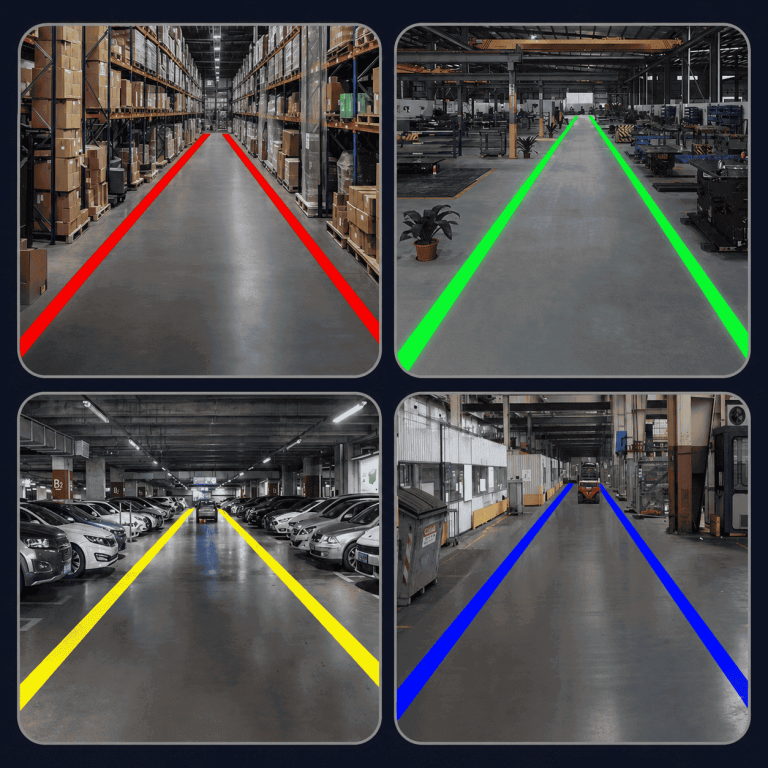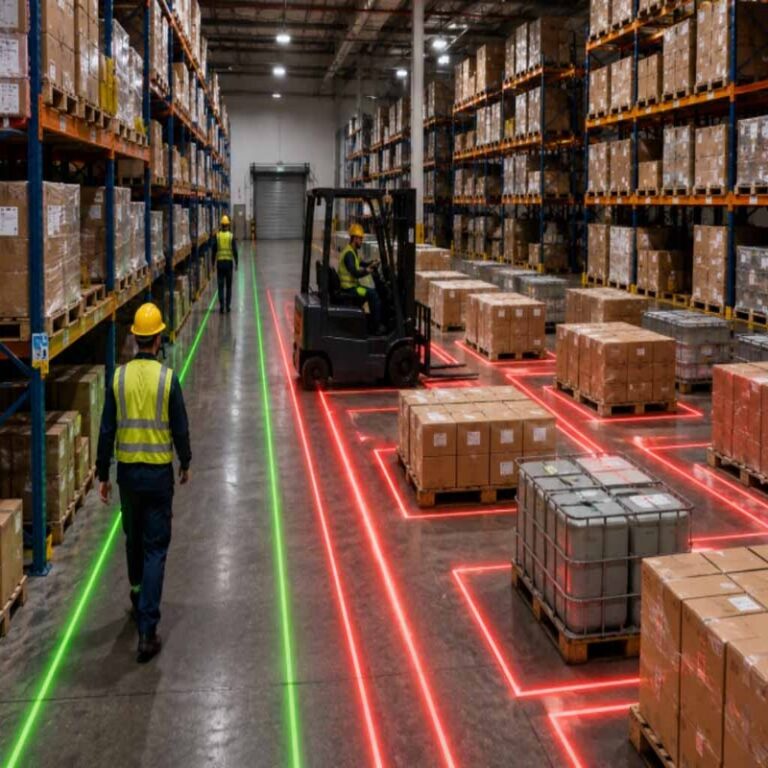

Warehouses are busy workplaces where forklifts and pedestrians often share the same space. Forklifts move goods between storage areas, loading zones, and production lines, while workers walk through aisles and crossing points every day. Without clear warning signs, accidents can happen when pedestrians and forklifts approach the same area.
Traditional floor markings are widely used to separate pedestrian walkways from vehicle routes. However, painted lines can become dirty, worn, or difficult to see after long-term use. A zebra projector offers another solution by projecting clear pedestrian crossing patterns and warning signs directly onto the warehouse floor.
For warehouses that need permanent pedestrian crossings and automatic forklift warnings, projection systems can provide a flexible visual safety solution.
1. Why Use a Zebra Projector in a Warehouse?
A zebra projector uses light to display zebra crossing patterns on the floor. Unlike traditional painted markings, projected signs do not require direct contact with the floor.
This makes them suitable for warehouses with heavy forklift traffic, frequent floor cleaning, and changing operational needs.
| Traditional Floor Markings | Zebra Projector |
| Painted directly onto the floor | Projects patterns using light |
| May become worn over time | No direct floor contact |
| Requires repainting when damaged | No painted lines to maintain |
| Difficult to change after installation | Flexible image customization |
| Visibility depends on floor condition | Visibility depends on brightness and ambient light |
A zebra signage system can help workers identify pedestrian crossing areas more easily. It also provides forklift drivers with a clear visual reference when approaching shared traffic areas.
2. Permanent Zebra Crossing Projection for Pedestrians
For warehouses that need permanent pedestrian crossing signs, one projector can be installed at each designated crossing area.
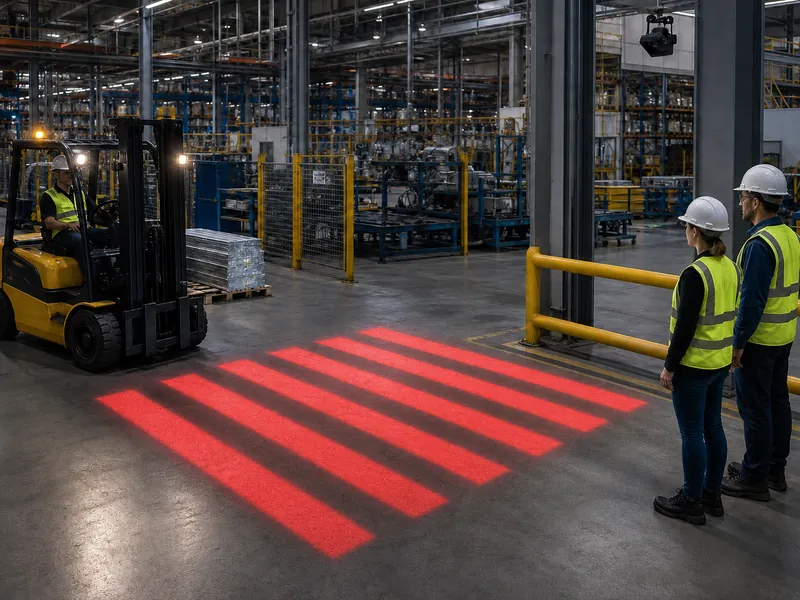
The projector can be mounted on the ceiling, wall, or another suitable structure to display white zebra stripes on the floor. The image remains active during normal operation, helping workers recognize where they should cross.
A zebra crossing projector can be customized according to the warehouse layout.
| Installation Factor | What to Consider |
| Installation Height | Determines projection size and image clarity |
| Projection Width | Should match the required crossing width |
| Projection Length | Should cover the intended crossing area |
| Ambient Lighting | Higher brightness may be needed in bright environments |
| Installation Position | Avoid obstacles that may block the image |
| Image Design | Customize stripe width, spacing, and pattern |
For example, if a warehouse has three pedestrian crossing points, it may install one permanent projection unit at each location.This approach helps create consistent visual crossing areas without relying entirely on painted floor lines.
3. Automatic STOP Signs for Approaching Forklifts
Permanent pedestrian crossings are useful, but they cannot always warn workers when a forklift is approaching.
To improve awareness, warehouses can add an automatic warning system that activates when a forklift enters a defined detection area.
The system typically includes a projector, detection sensor, and control unit.
How Does the Automatic Warning System Work?
| Step | System Operation |
| 1. Detection | A sensor detects an approaching forklift. |
| 2. Signal Transmission | The sensor sends a signal to the control unit. |
| 3. Activation | The control unit activates the warning projector. |
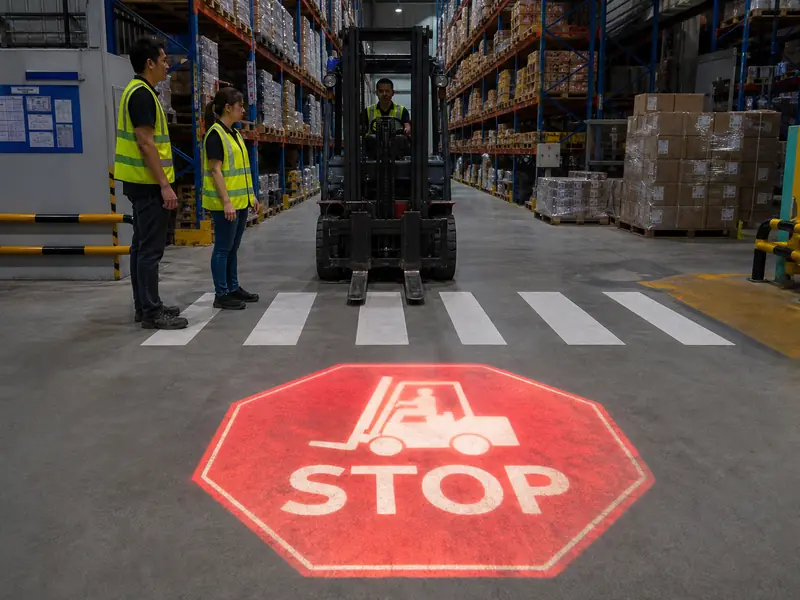
| 4. Warning Display | A STOP sign or forklift warning appears on the floor. |
| 5. Reset | The warning switches off according to the configured control logic. |
For example, when a forklift approaches a pedestrian crossing, the system can automatically project a STOP sign onto the floor to remind the driver to slow down and check the crossing area.
The activation distance, warning duration, and detection method should be selected according to forklift speed and the actual warehouse layout.
What Warning Signs Can Be Projected?
| Warning Projection | Main Purpose | Typical Application |
| STOP Sign | Reminds drivers to stop | Warehouse intersections |
| Forklift Warning | Alerts pedestrians to vehicle traffic | Shared pedestrian and forklift routes |
| Pedestrian Crossing | Marks a designated crossing area | Warehouse walkways |
| Directional Arrow | Shows traffic direction | Forklift routes |
| Custom Safety Text | Displays specific safety instructions | Loading and unloading areas |
The projected content can be customized according to different warehouse safety requirements.
4. Combining Permanent Crossings and Automatic Forklift Warnings
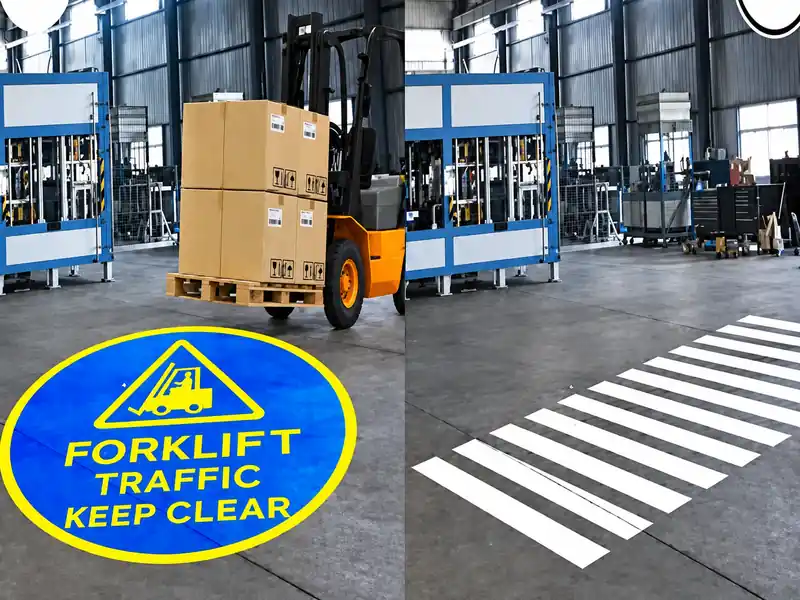
For warehouses that need both permanent pedestrian markings and automatic vehicle warnings, combining the two functions can provide a more complete visual guidance system.
The two projection functions have different purposes and can work together.
| Safety Function | Working Mode | Main Purpose |
| Permanent Zebra Crossing | Continuously projected | Identifies pedestrian crossing areas |
| Automatic STOP Sign | Activated by forklift detection | Reminds drivers to stop and check |
| Forklift Warning | Activated by sensor signals | Alerts nearby pedestrians |
| Custom Warning Graphics | Static or sensor-controlled | Provides additional safety information |
A typical warehouse installation may include:
One permanent zebra projector at each pedestrian crossing.
Automatic STOP warning projectors at important intersections.
Sensors positioned to detect approaching forklifts.
Customized warning images based on warehouse traffic rules.
The permanent crossing projection provides continuous guidance, while the sensor-based warning system responds to approaching vehicles.
Together, these systems help make pedestrian routes and forklift warning areas easier to recognize.
However, projected signs should be used as a visual safety aid alongside physical barriers, traffic rules, speed controls, and operator training. They should not replace other required safety measures.
5. How to Choose the Right Pedestrian Crossing Projector?
Selecting the right pedestrian crossing projector requires more than checking the projector’s wattage. The warehouse environment, installation height, projection distance, and required warning functions should all be considered.
| Selection Factor | Recommended Consideration |
| Brightness | Select suitable brightness for ambient lighting. |
| Projection Distance | Match the lens to the installation height. |
| Image Size | Confirm the required crossing width and length. |
| Image Customization | Support zebra stripes, STOP signs, and custom graphics. |
| Sensor Compatibility | Check whether automatic activation is supported. |
| Protection Rating | Choose suitable protection against dust and moisture. |
| Power Supply | Confirm the available power connection. |
| Installation Method | Consider ceiling, wall, or structural mounting. |
Before choosing a projector, it is helpful to provide the supplier with the installation height, required projection size, ambient lighting conditions, and warning functions.This information helps determine the suitable projector model and lens configuration.
6. Frequently Asked Questions About Warehouse Zebra Projectors
| Question | Answer |
| Can a zebra projector replace painted pedestrian crossings? | It can provide an alternative visual marking method, but it should be used according to the site’s safety requirements. |
| Can the projected zebra crossing stay on all the time? | Yes. A permanent projection can remain active during normal operation. |
| Can a STOP sign appear automatically? | Yes. With a compatible sensor and control system, the warning can activate when a forklift approaches. |
| Can different warning images be customized? | Yes. Zebra stripes, STOP signs, arrows, and custom safety messages can be designed. |
| Where can a zebra projector be installed? | Common installation positions include ceilings, walls, and suitable overhead structures. |
| What affects projection visibility? | Brightness, ambient light, installation height, projection distance, and floor conditions all affect visibility. |
7. A Flexible Visual Safety Solution for Modern Warehouses
As warehouse operations become more complex, clear pedestrian routes and forklift warning systems are increasingly important.
A zebra projector provides a flexible way to display permanent pedestrian crossings without directly marking the floor. When combined with sensor-activated STOP signs and forklift warnings, it can help improve visual awareness at important traffic points.
Whether a warehouse needs one permanent pedestrian crossing or a complete projection warning system, selecting the right equipment according to the actual site conditions is essential.
With customized projection patterns, suitable brightness, and compatible detection systems, warehouses can create clearer visual safety areas for both pedestrians and forklift operators.