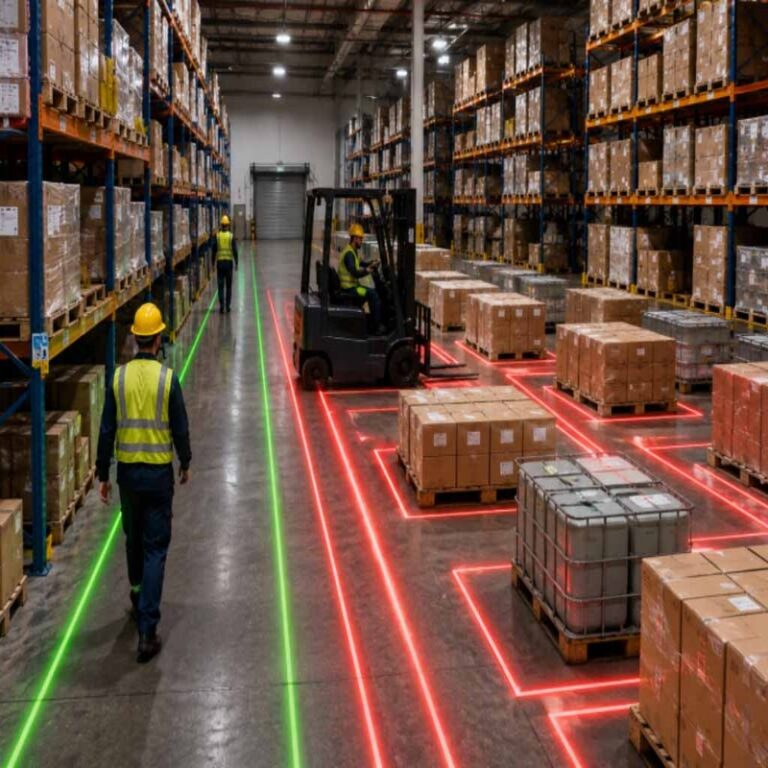

A warehouse can look well organized from above. Forklifts have their routes, workers have their walkways, and crossing points appear clearly marked on the floor. But what happens when a forklift turns into an aisle while a worker is walking across the same area?This is where a Zebra Crossing Projector can provide an additional visual warning. Instead of relying only on paint or floor tape, a projected zebra crossing can create a bright, easy-to-see crossing pattern directly on the floor.The idea is simple: make the crossing area visually obvious before a person or forklift reaches it.
The Problem Is Often the Crossing Point,Forklift routes and pedestrian routes do not always stay completely separate. In many warehouses, workers need to cross vehicle lanes to reach packing stations, storage areas, offices or production lines.OSHA recommends separating forklift and pedestrian traffic where possible and using designated pedestrian walkways. It also highlights the importance of marked aisles, warning signs and additional visibility measures at intersections and areas where visibility is limited.
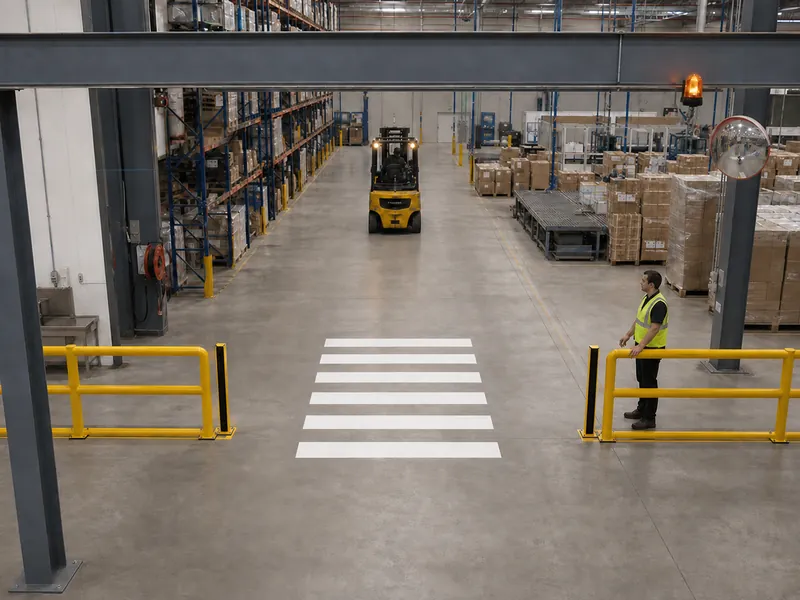
However, a painted crossing does not always remain highly visible. Heavy forklift traffic, dust, tire marks, cleaning and floor wear can gradually affect the appearance of traditional markings.This is one reason projected crossings are attracting attention in flexible industrial environments.The better question is not which one is always better. The more useful question is: Which solution fits the way the warehouse operates?
| Item | Traditional Painted Crossing | Projected Crossing |
| Formation Method | Paint or floor tape | Optical projection |
| Impact on Floor | Yes | No |
| Permanent Routes | Very suitable | Suitable |
| Changing Routes | Usually requires repainting or rework | Projection position can be adjusted |
| Long-Term Maintenance | Check for wear, dirt, and fading | Check the projector and projection quality |
| Flexibility | Lower | Higher |
| Visual Effect | Affected by floor condition | Affected by brightness, ambient light, and projection distance |
| Compatibility with Other Safety Measures | Yes | Yes |
For a warehouse with fixed traffic routes, traditional markings can still be a practical choice. For a facility where routes, machines or work areas change regularly, projection can provide another option without modifying the floor.
Where Does a Zebra Crossing Projector Make Sense?A Zebra Crossing Projector can be considered for locations where pedestrians and forklifts regularly share or cross the same space.For example, a zebra crossing projector for warehouse applications can mark the connection between a pedestrian walkway and a forklift aisle.In a manufacturing facility, a zebra crossing projector for factory can visually identify a crossing near production lines, packing areas or material handling routes.For forklift safety, a projected crossing can also become part of a broader visual safety system. A zebra crossing projector for forklift safety may work alongside warning lights, signs, mirrors, barriers and workplace traffic rules.
What If the Warehouse Layout Changes?This is where projection becomes interesting.Imagine a factory adds a new production machine. The original forklift route now needs to move two meters to one side. With traditional paint, the old crossing may need to be removed and a new one marked.With projection, the equipment can potentially be repositioned to match the new route, depending on the projector installation and optical configuration.This makes forklift pedestrian crossing projection particularly interesting for warehouses that regularly change production areas, storage zones or traffic routes.
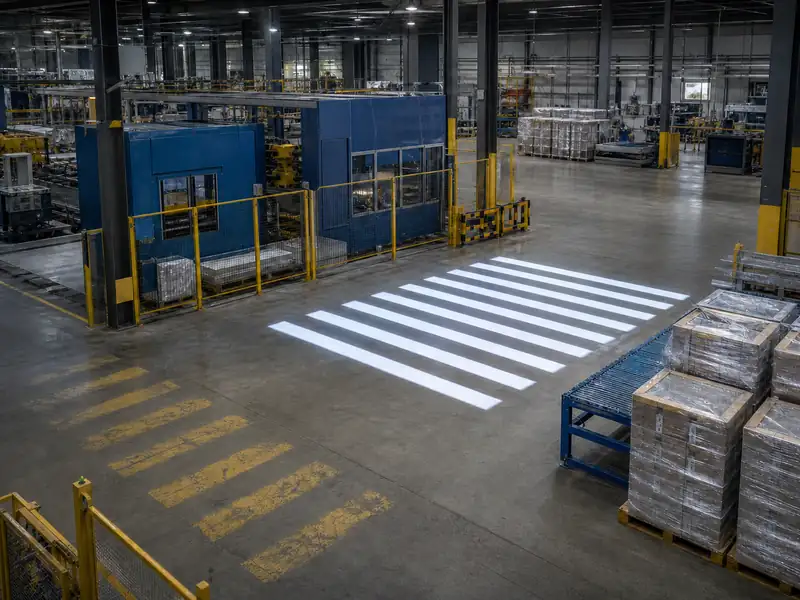
In May 2026, a manufacturing warehouse in Vietnam wanted to improve visibility at a pedestrian crossing located beside a forklift loading route. Workers frequently crossed the vehicle lane to reach the packing area, while forklifts entered the same zone during material movement. The existing painted crossing was still usable but became less noticeable under dust and strong overhead lighting. The team installed a projected zebra crossing near the shared route and adjusted the projection position according to the mounting distance. After testing, the crossing became a more visible visual reference for workers and forklift operators. The warehouse kept the original floor markings and used the projected crossing as an additional warning layer.
How Should You Choose the Projector?The most powerful projector is not automatically the best projector.Before selecting a system, consider:
Mounting height — How high will the projector be installed?
Projection distance — How far does the light need to reach the floor?
Ambient light — Is the warehouse brightly lit during working hours?
Required crossing size — How wide and long should the projected zebra crossing be?
Floor condition — Is the floor dark, reflective, uneven or dusty?
Layout flexibility — Will the traffic route change later?
These factors are often more useful than simply choosing a projector based on wattage.
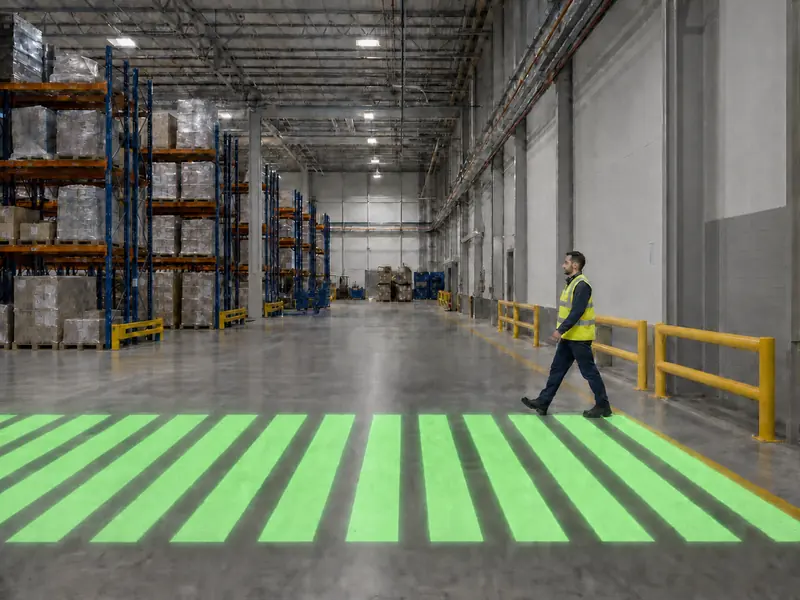
Noparde develops industrial projection solutions for forklift routes, pedestrian crossings, warehouse areas and factory applications. The final product selection should be based on the actual installation height, projection distance, ambient light and required image size.The goal is simple: make important crossing areas easier to notice, easier to understand and easier to manage.A Zebra Crossing Projector can provide a flexible visual layer for warehouses where forklifts and pedestrians need to share the same working environment.