
In July 2025, an industrial warehouse in eastern China faced a common safety problem during night loading. Forklifts moved between material stacks and waiting trucks, while loaders, inspectors and truck drivers worked nearby.
The site already had painted traffic lines. However, dust, pallets, parked trucks and weak light often covered these markings. More importantly, a fixed line could not show the changing danger area around a moving forklift.
The customer needed a warning that could move with the vehicle. After reviewing the loading process, our team began planning a forklift traffic lights system that could project a clear red boundary onto the ground.
Why Were Painted Lines No Longer Enough?
Painted floor lines still had value. They showed the normal vehicle route and helped workers understand the site layout. However, they could not answer one important question: where is the immediate danger area right now?
The forklift did not always travel in a straight line. It turned, reversed and moved close to different trucks. Its rear counterweight also moved sideways during a turn. A worker standing outside a painted lane could still be too close to the forklift.
The old system had several practical problems. Floor markings became dirty or worn, pallets and trucks sometimes covered the lines, and night lighting reduced their contrast. The markings also stayed in one place while the forklift continued to move.
This was the reason for adding forklift traffic lights. The goal was not to remove the painted routes, but to add a moving visual warning around the forklift.
What Did the Customer Require?
The customer did not simply ask for a brighter light. The red line had to be visible on the concrete floor at night, move with the forklift and remain clear while the vehicle was turning.
The light could not block the driver’s view or interfere with normal lifting work. Installation also needed to cause little interruption to daily operations, and the warning had to be easy for drivers and pedestrians to understand.
The selected forklift traffic lights needed adjustable mounting because the vehicle height, installation point and distance from the light to the floor were different at each position.
How Did the Moving Red Boundary Work?
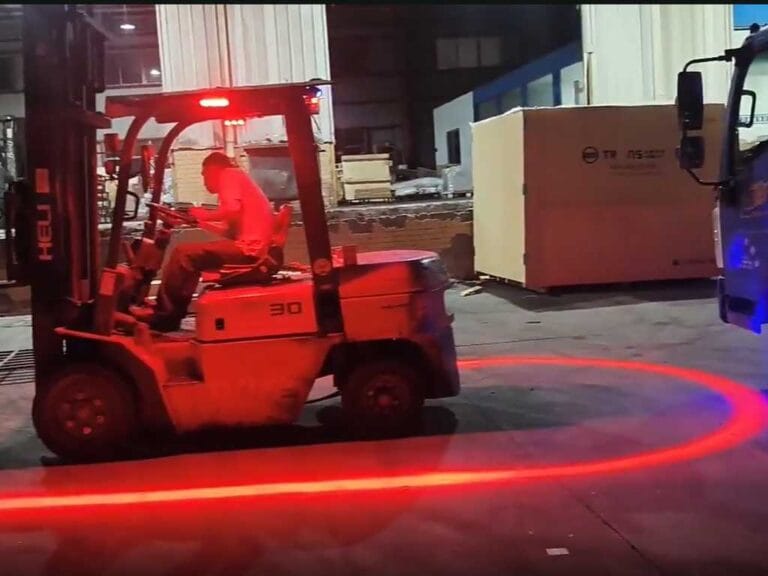
We installed and adjusted a forklift U shaped safety light system around the forklift. The lights projected red lines behind and beside the vehicle, creating a U-shaped warning area on the floor.
Instead of relying only on a fixed walkway line, nearby workers could now see a boundary that moved with the forklift.
The customer also described the product as a forklift red danger light because its message was simple: when the forklift was moving, people should remain outside the red line.
This forklift red light safety setup was especially useful during truck loading. Drivers and warehouse workers often needed to stand near the loading area, but they did not always know how much space the forklift required when reversing or turning.
The projected red line provided an immediate visual cue. Workers did not need to estimate the distance or search for a faded floor marking.
After the system was adjusted, the site could give workers a simple instruction: when the forklift is active, stay outside the projected red U-shaped line.The forklift red zone light made this rule easier to explain during safety meetings. It was also easier for truck drivers, temporary workers and first-time visitors to understand.The value of the forklift traffic lights did not come from replacing the old system. It came from connecting the forklift’s current position with a clear moving warning.
This project shows why a night loading area should not depend on only one warning method. Painted lanes organize traffic, barriers keep people apart, training explains the rules, and projected lights make the active warning area more visible.
A similar system may be considered in warehouses, metal plants, building-material yards and other sites where forklifts operate close to trucks or workers. However, the mounting position and warning distance should always be checked against the real site conditions.
For companies evaluating forklift traffic lights, the first question should not only be, “How bright is the light?” A better question is: “Where do people approach the forklift, and what warning will they notice before getting too close?”
When correctly installed and supported by site rules, a forklift U shaped safety light can add a clear moving boundary to a busy loading operation. This makes forklift traffic lights a useful part of a wider forklift and pedestrian safety plan.