

A crosswalk projector puts a crossing pattern on pavement or floor so drivers and pedestrians share the same visual cue. Buyers usually face two jobs: a night road crossing under streetlamps and headlights, and a warehouse or yard path where forklifts and people share an aisle. This guide helps you decide which environment you are buying for, what to check before you order, and when “crosswalk” language fits better than “zebra”—without treating projected light as a substitute for site safety rules.
For a live outdoor night example, see our crosswalk projector case at a road crossing in Turpan. That article is proof of one outdoor install. The notes below are the selection decision tree that should come before you pick a fixture or pattern.
What a crosswalk projector does (and does not do)
A crosswalk projector casts a visible crossing or path cue onto the surface people already watch while moving—road asphalt, concrete yard, or warehouse floor. Typical patterns include zebra bars, a pedestrian symbol, and short yield or stop wording. Because the marking is made of light, it can stay readable after dark and can be re-aimed if traffic routes change.
It does not replace painted markings where the site still needs them, traffic signals, speed control, training, or the written safety process for that site. Treat the projector as a high-visibility complement: it answers “where is the shared path right now?” so approaching vehicles and pedestrians can react earlier. If your team cannot say who owns mounting, aiming, and cleaning after install, fix that ownership before you buy hardware.
Two common environments: night road crossings vs warehouse / yard paths
Outdoor night road crossings compete with streetlamps, shop signs, LED boards, and vehicle lights. Throw distances are often longer, approach speeds are higher, and weather and permissions matter. Pole-arm or wall mounts above the roadway are common. The Turpan night crossing shows how zebra bars and yield text can sit in the driver’s forward view on a bright commercial street—use that case for outdoor context, not as a copy-paste bill of materials.
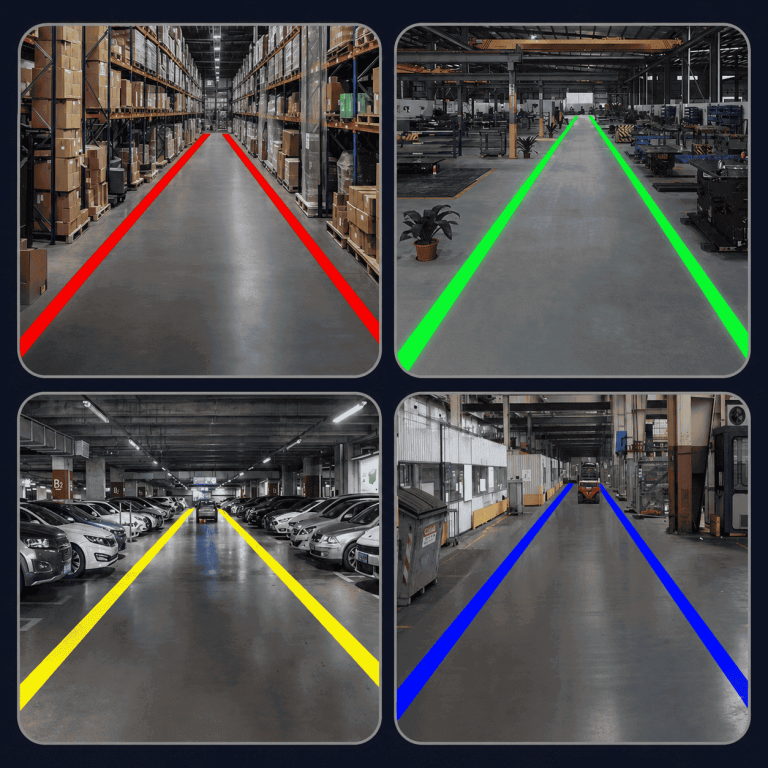
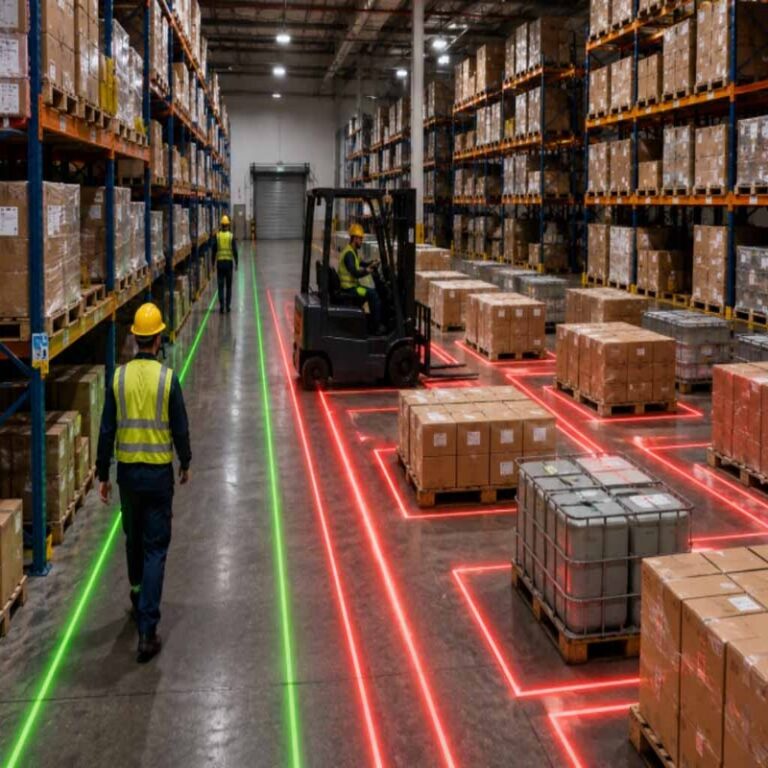
Warehouse aisles, covered yards, and dock approaches mix forklifts, pallet jacks, and pedestrians under high-bay lighting that may already wash the floor. Layouts change when racks move or temporary routes open. Here a projected pedestrian crossing for warehouse traffic is often judged by aisle width, mounting height on a beam or column, and whether the pattern stays clear under bright ambient light. For indoor forklift–pedestrian awareness, read how a zebra crossing projector improves forklift and pedestrian safety in warehouses.
Rule of thumb: public or plant-road vehicles after dark → outdoor road job. Shared indoor or covered paths with material-handling equipment → warehouse / yard job. Mixed gate-to-yard sites need both ambient-light and vehicle-speed notes on the same RFQ.
Selection checklist before you buy
Confirm these points on site or from clear photos and measurements. Keep answers qualitative until someone verifies them in person—do not buy from a wattage claim alone.
- Mounting height and aiming path — Where can the fixture sit (pole arm, wall, beam, column)? What tilt covers the crossing without heavy keystone distortion? Note obstacles that block the beam.
- Pattern role — Zebra stripes alone, or companions such as stop / yield text, arrows, or a pedestrian symbol? Match wording to local rules outdoors; indoors, prioritize high-contrast bars that stay readable when paint would scuff.
- Duty cycle and who walks the path — Shift-change crowds, dock peaks, public sidewalk edges, and quiet night gates stress visibility differently. Say who uses the path and when.
- Ambient light — Daylight, high-bay wash, headlights, and illuminated signs all reduce contrast. Ask for day and night photos of the same spot.
- Power and exposure — Confirm supply at the mount and whether the fixture faces rain, dust, or wash-down. Exact ratings belong on a verified product sheet for the chosen unit—not in a generic guide.
- Maintenance ownership — Who cleans the lens and pattern optic, who re-aims after a rack move, and who holds spare access? Unowned maintenance is a common reason a projector “stops working” in year two.
- Permissions — Road owners and local rules may restrict projected markings on public pavement; plant EHS may require a documented crossing location indoors.
When you are ready to compare standard industrial crossing patterns, browse our zebra crossing projectors category, then send height and ambient-light notes through Contact us for a layout review.
When “crosswalk” wording fits vs “zebra” wording
In practice, a crosswalk projector and a zebra-style unit often point at the same product family: a fixture that throws crossing stripes (and sometimes text or symbols) onto a shared path. Language still differs by region: North American plant and municipal buyers often say “crosswalk”; many warehouse teams say “zebra” or “pedestrian crossing projector.”
Use crosswalk framing for outdoor-vs-indoor selection, municipal or plant-road crossings, or RFQs that already use that word. Lean on zebra when the reader is deep in warehouse forklift–pedestrian segregation. Keep this page anchored on crosswalk projector; send warehouse-intent readers to the product hub and the forklift safety article above rather than duplicating those H2s.
If you only need warehouse aisle depth (forklift lanes, docks, temporary routes), the existing virtual zebra crossing projector warehouse selection guide stays the warehouse-focused companion. This guide stays on the outdoor-vs-warehouse decision and the crosswalk naming buyers bring to RFQs.
Layout pitfalls that waste a projector
- Aiming into glare or under bright high-bays — A pattern that looks sharp in a dark demo bay can disappear under strong overhead lighting. Always judge contrast in the real ambient condition.
- Crossing placed where drivers cannot react — If the first view of the bars is after a blind corner or past braking distance for that vehicle type, the light arrives too late. Fix geometry before chasing brightness claims.
- No measured height or span — Guessing throw distance leads to undersized stripes or heavy distortion. Bring approximate mounting height, crossing width, and a photo with a known reference object.
- Pattern clutter — Stacking too much text, symbols, and bars in a short throw makes the message unreadable at speed. Prefer one clear primary cue plus one short secondary line if needed.
- Orphan install — Fixture mounted, no owner for cleaning or re-aim after layout changes. Build maintenance into the handover.
Next step: match a pattern and request a layout review
Summarize your environment in one sentence (night road crossing vs warehouse / yard path), attach day and night photos, and list mounting height, crossing width, vehicle types, and who walks the path. We will reply with a suggested pattern role and a short list of items still to verify on site—without promising unverified performance numbers.
Browse zebra crossing projectors for current industrial options, revisit the Turpan night road-crossing case if you need outdoor reference photos, and contact us to start a layout review.
[…] The job is an outdoor night crossing. Ambient light from shops, streetlamps, and headlights is part of the scene. For how this differs from a warehouse path, see the crosswalk projector selection guide for outdoor roads and warehouse paths. […]