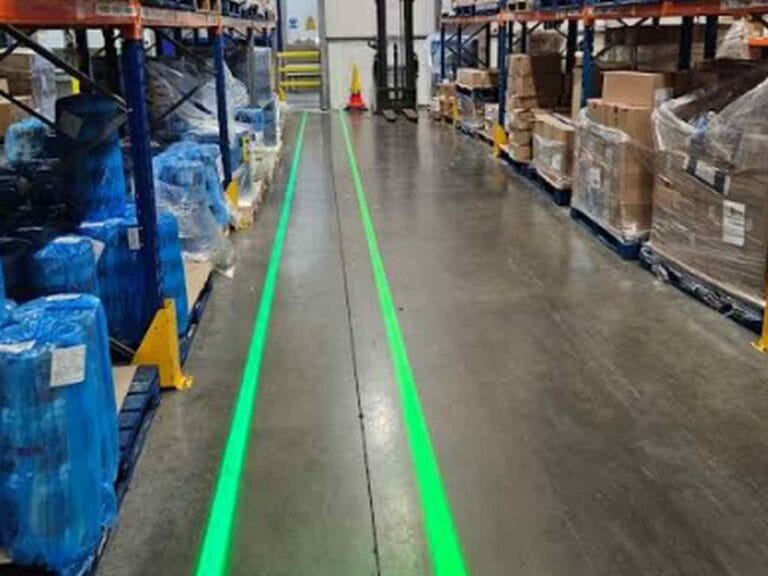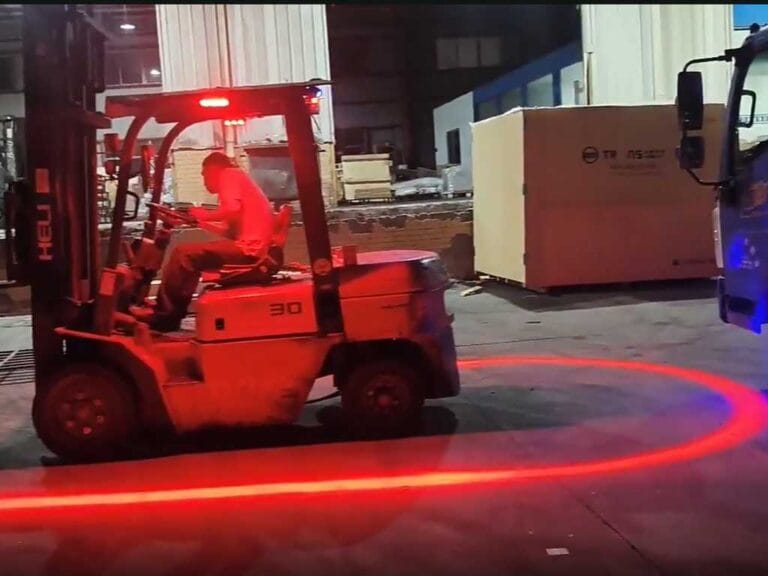

In warehouses, factories and loading areas, pedestrian routes are often marked only by painted lines that wear under traffic, floor tape peels at the edges, and static signs that regular staff stop noticing. Where forklifts and pedestrians share the same aisles, that fading visibility creates a daily crossing risk. A zebra projector offers a different approach, replacing worn markings with projected warning signs displayed directly on the floor or road surface. The pictured case, from a nighttime urban road in the UK in December 2025, shows broad yellow-and-white stripes illuminated across dark asphalt as a small group of pedestrians walk across the centre, illustrating how the same idea can support safer crossings in logistics and industrial sites.
A December 2025 UK Road Case: A Zebra Crossing After Dark
The cover image from the December 2025 case in the UK shows the basic idea in a public-road setting rather than a warehouse. After dark, a broad illuminated zebra crossing spans dark asphalt, its wide horizontal stripes in alternating yellow and white remaining clearly visible across the carriageway. A small group of pedestrians is walking across the centre, with a pole on the left and light-coloured cars and faint distant lights in the background. No projector unit is visible in the frame, and no projected wording is readable.
For safety managers, the value of the case is the layout, not the location. A zebra projector creates that defined crossing as light, so the route, stopping point and pedestrian priority can be shown where people actually walk. The same approach can be assessed for warehouse aisles, loading areas and site entrances where painted markings are worn, obscured or difficult to change.
How a Zebra Projector Creates a Virtual Crossing
A zebra projector is mounted above or beside a crossing point, on a pole at a roadside or on a column, wall or ceiling structure in a warehouse, and casts a defined pattern onto the surface below. In the December 2025 UK road case, that pattern was broad stripes across dark asphalt, forming a virtual zebra crossing projection for pedestrian safety that remained visible at night without relying on worn paint. The same principle applies indoors: a warehouse zebra crossing projector light can project stripes, borders and pedestrian symbols onto concrete at aisle ends, dock approaches and forklift routes, or warning symbols onto walls where floor space is limited. Because the crossing is light rather than a fixed marking, managers can reposition the unit, change the projected image or adjust its orientation when racking, traffic routes or site layouts change. Before specifying, confirm mounting height, surface condition, ambient light and viewing angles against your own site conditions.
Where It Helps Most: Roads, Warehouses and Logistics Centres
In the December 2025 UK road case, the benefit is visible at night: wide horizontal stripes in alternating yellow and white span the dark asphalt, with a small group of pedestrians walking across the centre and light-coloured cars visible beyond the crossing. The same approach helps where people and vehicles meet indoors.
In warehouses and logistics centres, place a warehouse zebra crossing projector light at aisle ends, blind intersections, pedestrian gates and routes between racking and dispatch areas, so the crossing is seen before a forklift or pallet truck arrives. At loading docks, use it at bay entrances, trailer access points and shared yard-to-building thresholds, where reversing vehicles, roll cages and foot traffic converge.
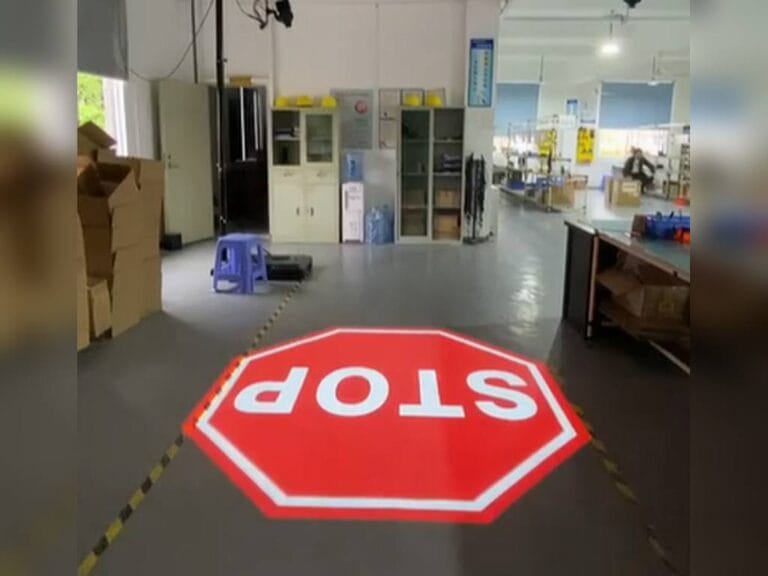
Pair the crossing with projected floor warning signs for logistics centres, such as stop, look or pedestrian-priority symbols, and keep routes, responsibilities and sightlines defined in your traffic management plan. Confirm suitability against your lighting, surface and traffic conditions before specifying.
Visibility in Bright, Dark and Dusty Environments
The nighttime road scene in the cover photo shows why context matters: wide yellow and white stripes stand out clearly against dark asphalt after dark. The same projection may look very different in a warehouse at midday, under skylights, or near open dock doors.
Surface is the first variable. Smooth, clean, light-coloured concrete can diffuse a projection, while dark, rough, wet or marked floors can change contrast and edge definition. Ambient light is the second. Bright overhead lighting, daylight from windows, and vehicle headlights can wash out a warehouse zebra crossing projector light, especially at shift changes when traffic peaks. Dust is the third. Airborne dust in loading, packing or production areas can scatter light, and dust or tyre marks on the floor can dull the image over a shift.
Do not judge legibility from a photograph or darkened demonstration alone. Arrange a trial on the actual crossing and floor finish, during the brightest and busiest operating periods, and check visibility from pedestrian and forklift approach directions before deciding.
Installation and Placement for Roads and Indoor Sites
Start by confirming the crossing route, then choose the mounting position. On a road, this usually means a pole or structure at the roadside, positioned so the projection covers the width of the crossing without being blocked by vehicles. Indoors, a warehouse zebra crossing projector light can be mounted on a column, wall or ceiling structure above or beside the walkway, clear of forklift masts, racking and stored goods.
Keep the projection angle as direct as the site allows. An oblique angle can stretch the stripes, reduce clarity at the far edge and create blind spots, while a position too close to traffic increases the risk of knocks and misalignment.
Before final fixing, run a coverage check in real conditions. Walk the approaches from both directions, check that every stripe is complete, visible and aligned with the pedestrian route, and view the crossing in normal and low light. Confirm the setup on site with your safety and maintenance teams, and recheck it after layout or lighting change.
How to Choose the Right Setup and Maintain It vs Paint and Tape
Start with a site walk-through. Map each crossing point, pedestrian route, forklift turning area and blind corner, then note mounting positions that keep the projection clear of racking, parked vehicles and stacked goods. Check floor surface, colour and condition, ambient light at different shifts, and whether dust, moisture or cleaning routines could affect visibility. Confirm traffic volume, direction and peak times, and involve operators and pedestrian representatives in a short trial before fixing layouts.
When selecting a zebra projector, match the projected pattern to the crossing width and the message staff need at a glance, and confirm specifications with the supplier against your actual mounting height, surface and lighting. Keep the lens clean and mounting secure, include the crossing in routine safety inspections, and adjust the layout if routes or storage areas change.
By comparison, paint fades under forklift traffic and tape lifts at edges, requiring preparation, drying or replacement and planned closures. Projection avoids that surface wear, though it still needs periodic checks.
FAQ
Will a zebra projector remain visible at night and in busy working areas?
A zebra projector creates a virtual zebra crossing projection for pedestrian safety by displaying high-contrast stripes directly onto the road or floor surface. In the cover photo from the nighttime urban road example, the wide yellow and white stripes remain clearly defined across dark asphalt while pedestrians cross. Actual visibility will vary with ambient light, surface colour and condition, and mounting position, so a site test under normal operating conditions is recommended before final selection.
How is a warehouse zebra crossing projector light installed?
It is usually mounted overhead on an existing ceiling, pole, or structure and aimed at the intended crossing area, then focused and aligned so the stripes cover the walkway correctly. Installation should be planned around a suitable power supply, safe access for adjustment, and the movement of forklifts and pedestrians below. A qualified installer should confirm the mounting method and final position for your building.
Will projected markings wear out like paint or floor tape?
The projected image itself does not wear away from foot traffic or vehicle tyres because there is no paint or tape on the surface to scuff or peel. The projector still operates in an industrial environment, so lens cleanliness, mounting stability, and general equipment condition should be checked as part of routine maintenance. This helps keep the crossing consistent without repeated repainting of the floor.
How do I choose the right industrial pedestrian crossing projection system for my site?
Start by mapping where pedestrians cross vehicle routes, the width of the crossing, surface and lighting conditions, and where a unit can be mounted safely. From there, the same approach can be extended to projected floor warning signs for logistics centres, such as stop lines and walkway boundaries at intersections and dock approaches. Share photos, a simple site plan, and operating hours with your supplier so the proposed setup can be confirmed against your site conditions.
Conclusion
The December 2025 UK road case shows the core value of a projected crossing: a clear, visible warning where pedestrians and vehicles meet. The same principle transfers to warehouse aisles, loading areas, factory entrances and logistics centres, provided the route, surface, ambient light and traffic pattern are assessed first. Decision-makers should confirm whether projection remains legible in normal operation, how it supports existing safety procedures, and which specifications suit their own site conditions rather than assuming a road installation will translate directly. To explore the next step, view the WarningProjector zebra projector product page or request a quote for your site.